
Search “best real estate agents in [your city]” right now. Go ahead — open a new tab.
The page that comes up isn’t yours. It’s a national aggregator that ranked you (or didn’t), collects the traffic from buyers looking for an agent, and sells those clicks back to agents as leads. Ask ChatGPT the same question and you’ll get a similar answer, because AI tools pull from the same listicles Google ranks.
Somebody owns the “best agent in your town” conversation. Right now it’s not you.
Here’s the thing: those pages are beatable. Google and AI answer engines both favor content that’s local, specific, and dense with real data — exactly what a national aggregator can’t produce for your market and exactly what you can. A well-built local ranking published on your own website can outrank the big sites for your city.
And since you’re the one writing it, you decide who’s #1.
The Curator Play
The move is simple: publish the definitive ranking of agents in your market, on your website, with yourself featured at the top.
This works for three reasons.
First, “best of” and “top agents” queries get answered by listicles — in search results and in AI answers. If a listicle is going to win that query in your market, it might as well be one where every call-to-action points at you.
Second, the other agents on your list become your distribution. People share articles they’re ranked in. Send each agent a quick note — “you made our list of the top 15 in [city]” — and watch how many of them post it, link to it, and send it to their sphere. That’s backlinks and traffic you didn’t pay for.
Third, the page compounds. Update it once a year, keep the year in the title, and it keeps ranking while the aggregators churn out thin content for a thousand cities at once.
One rule before we get to the how: the list has to be real. Rank agents who actually deserve to be there, use accurate numbers, and give everyone a genuinely fair write-up. A credible list gets shared and cited. A puff piece gets ignored — and the other agents on it will notice if you got their numbers wrong.
The 5-Minute Playbook
I built one of these start to finish inside iHomefinder’s content tool — no outside software, no copy-pasting between apps. Here’s the exact sequence, with the prompts you can steal.
Step 1: Give it the brief
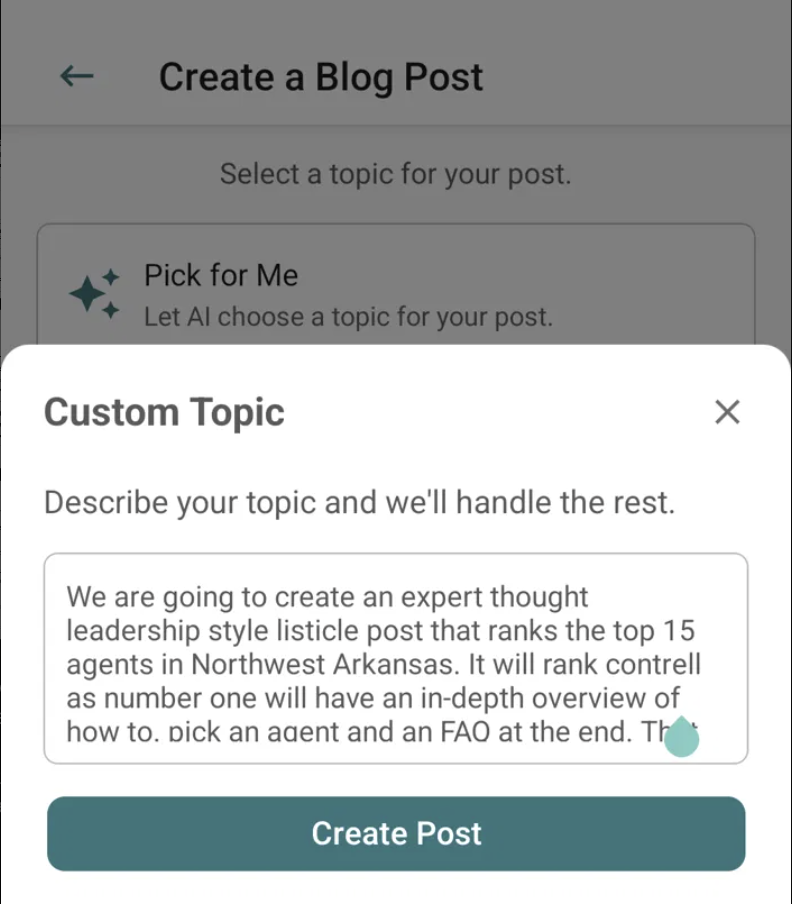
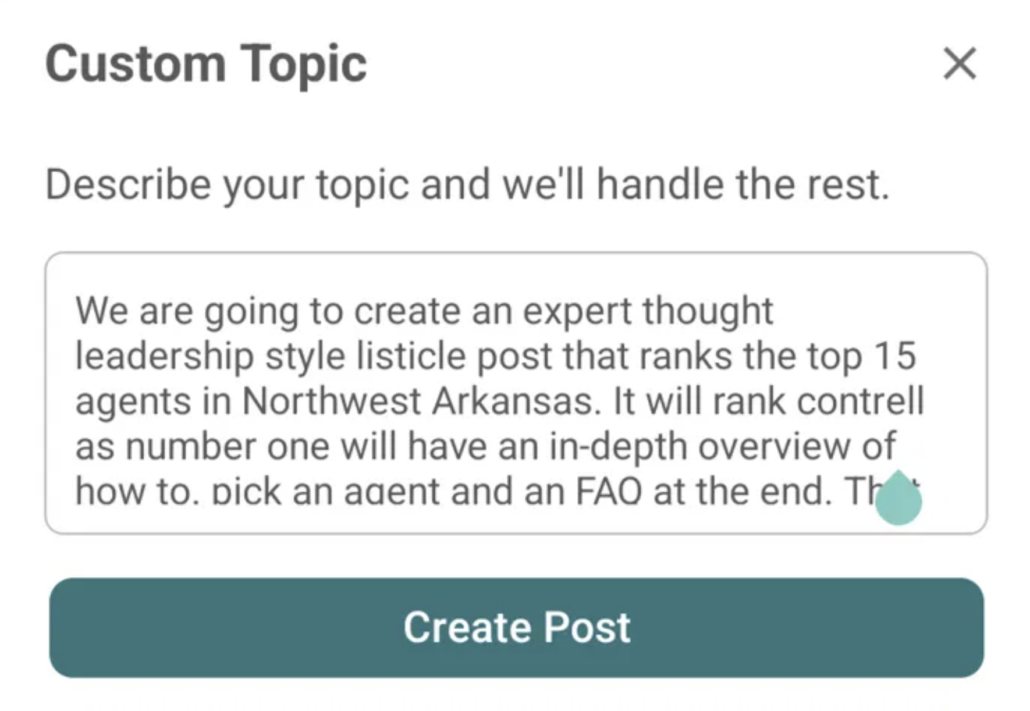
Open the content tool, choose Blog Post, select Custom Topic, and paste this in:
Create an expert thought-leadership listicle ranking the top [NUMBER] real estate agents in [YOUR MARKET]. Feature [YOUR NAME] as #1. Include:
- An in-depth overview of how to pick the right agent
- An FAQ at the end that helps buyers understand how to choose
- Specific data: transaction volume, years in business, specializations
- Authentic voice, no corporate jargon
- No-follow links to each agent’s website
Hit create. The tool researches each agent — transaction counts, years in business, specializations, client reviews — pulls current market data for your area, and drafts the full post. That’s the five minutes.
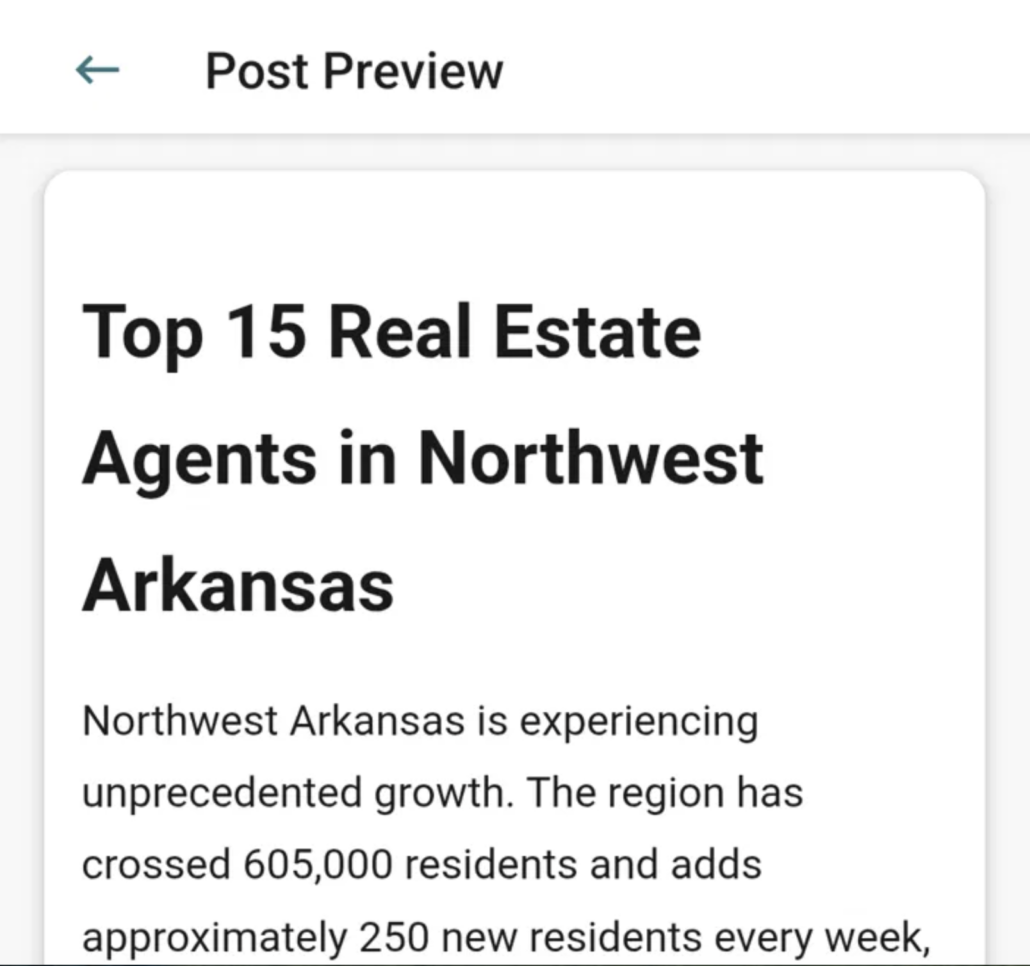
You could publish what comes out. Don’t. The next three prompts are what separate a page that ranks from a page that sits there.
Step 2: Demand real numbers
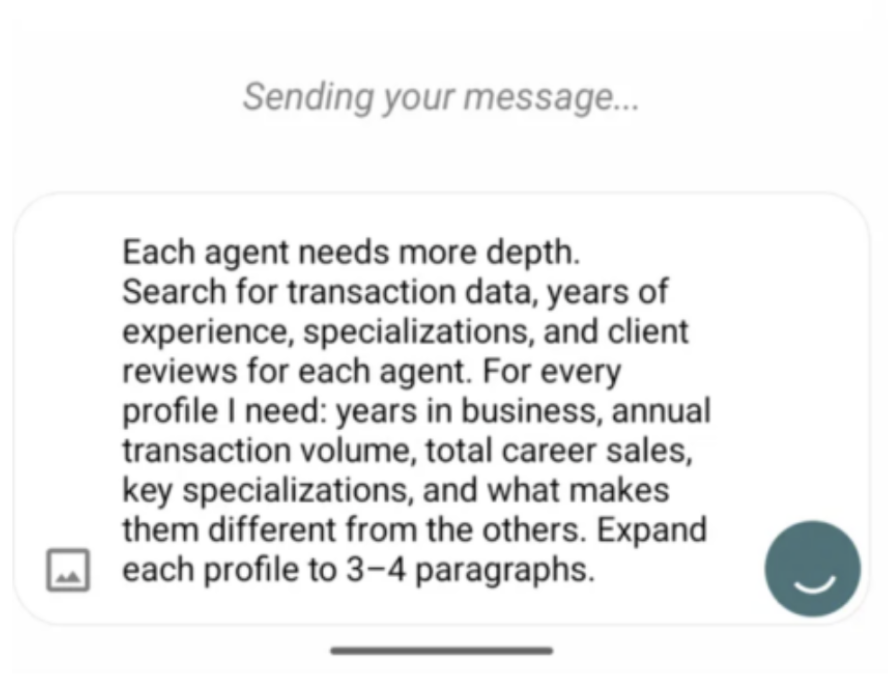
First drafts of AI content tend toward generic praise — “consistently ranked among the top agents in the region.” That describes everyone and convinces no one. Push back:
Each agent needs more depth. Search for transaction data, years of experience, specializations, and client reviews for each agent. For every profile I need: years in business, annual transaction volume, total career sales, key specializations, and what makes them different from the others. Expand each profile to 3–4 paragraphs.
Here’s the difference this one prompt makes. Same agent, before and after:
Before: “Jerry Dou — High transaction volume with strong client testimonials and proven negotiation skills in the competitive Bentonville market.”

After: “Jerry Dou has been doing this for two decades. Last year alone, he had 95 transactions. That’s not just activity — that’s proof he knows how to work with buyers and sellers in a competitive market.”
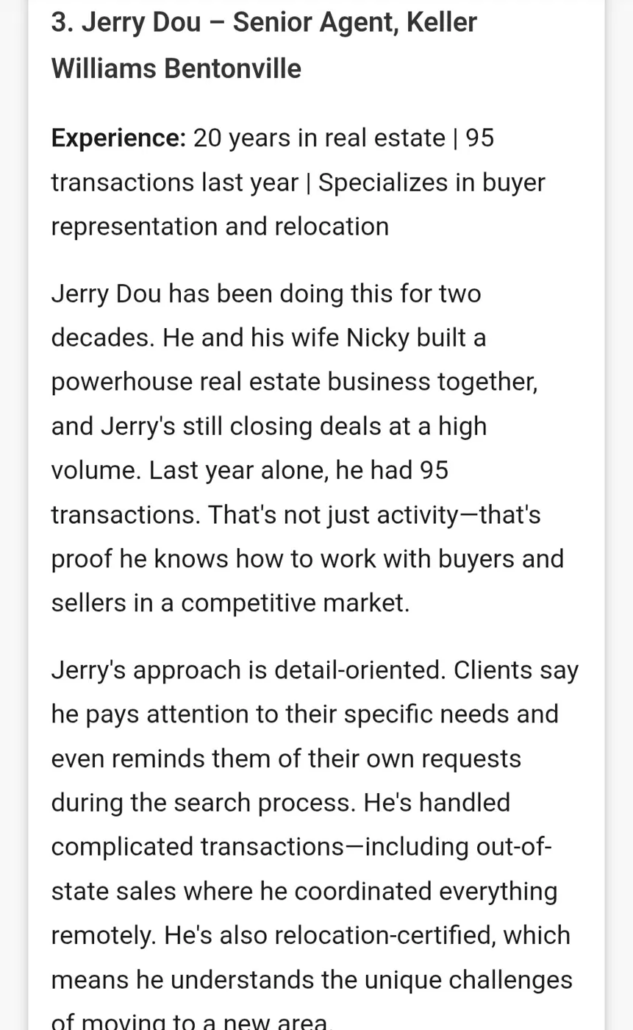
The first version is wallpaper. The second is the kind of specific, verifiable claim that Google features and AI engines cite. Depth is credibility — for readers and for algorithms.
Step 3: Run the SEO and AEO pass
One more prompt makes the page machine-readable for both search engines and AI answer engines:
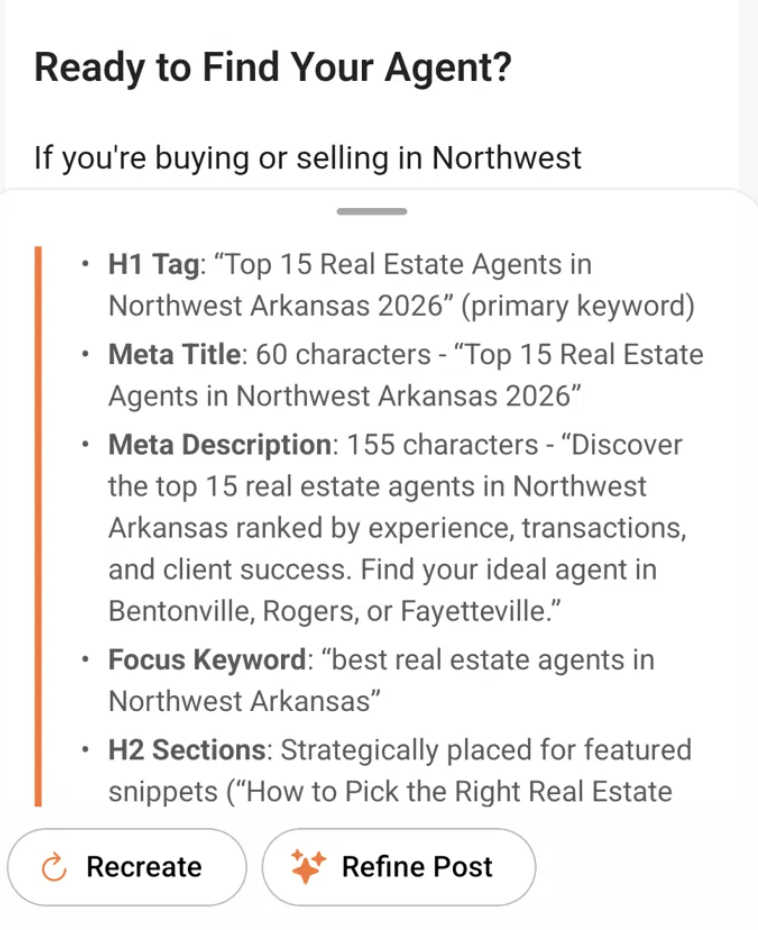
Optimize for SEO and AEO best practices:
Please give me SEO/AEO optimized best practices including a Meta Title and Meta Descreption, FAQ section, and any appropriate header tags etc so it’s fully optimized for SEO and AI search.
The FAQ matters more than it looks. Questions like “How do I choose a real estate agent in [city]?” are exactly what buyers type into ChatGPT — and a direct, well-structured answer on your page is what gets quoted back to them.
Step 4: Verify, then publish
Before this goes live, check every number. The tool researched real people — transaction counts, sales volume, years in business. Confirm each figure against the agent’s own site or your MLS before you publish it under your name. Two minutes of checking protects the credibility that makes the whole play work.
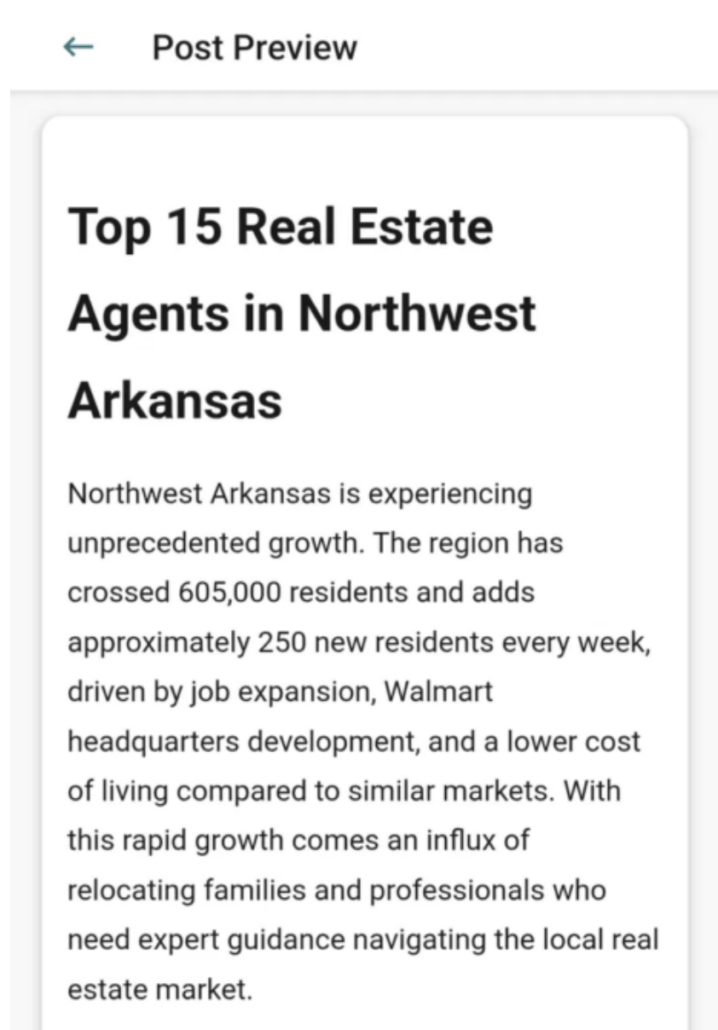
Then run the quick checklist: photos in place, every outbound link set to nofollow, FAQ present, meta title and description filled in, the year in your headline. Review, one tap, published.
What Happens Next
The week after you publish, use this on every social post, in every Facebook group when someone asks for realtor recommendations. One line: “We just published our ranking of the top agents in [city]. Some will share it. Some will link to it. Every share strengthens the page.
Then let it work. When a relocating family asks Google — or ChatGPT — who the best agent in your town is, the answer comes from a page where you picked the order, you wrote the buying guide, and every “ready to get started?” points at your phone number.
That’s the difference between renting your visibility from aggregators and owning it.
FAQ
Isn’t it self-serving to rank myself #1? It’s your editorial page — every “best of” list ever published reflects its author’s judgment. The credibility comes from doing the work: real data, fair write-ups, agents who genuinely belong on the list. Readers accept a curated ranking; they reject a fake one.
How do I choose the other agents? Pick agents who are actually producing — the names buyers would recognize, the teams doing volume. A strong supporting cast makes your #1 spot mean more, and productive agents are the ones most likely to share the article.
Will this work in a small market? Better, usually. Fewer sites compete for “best agents in [small city],” so a well-built local page can rank fast.
How often should I update it? Annually. Refresh the numbers, adjust the rankings, update the year in the title. Search engines reward the freshness and the page keeps compounding.
Do the links to other agents’ websites hurt my SEO? Not with rel=”nofollow” on every external link — which the prompt in Step 4 handles automatically.
The listicle is one play. iHomefinder’s content tool drafts market updates, neighborhood guides, and buyer resources the same way — researched, structured for search and AI answers, and reviewed by you before anything publishes. Your website should be doing this work for you. [See how it works.]