

The first post in our customer education series covered the foundation. Your real estate website and property search work as one system to turn visitors into contacts and contacts into business.
RECAP: Website and Property Search—Owning Your Real Estate Website
But a foundation without sustainable traffic easily turns into an empty building. Something has to bring people in. Something has to give search engines and AI tools a reason to send visitors your way. And something has to keep your existing contacts engaged week after week without you manually following up with every single one of them.
That something is Market Pages.
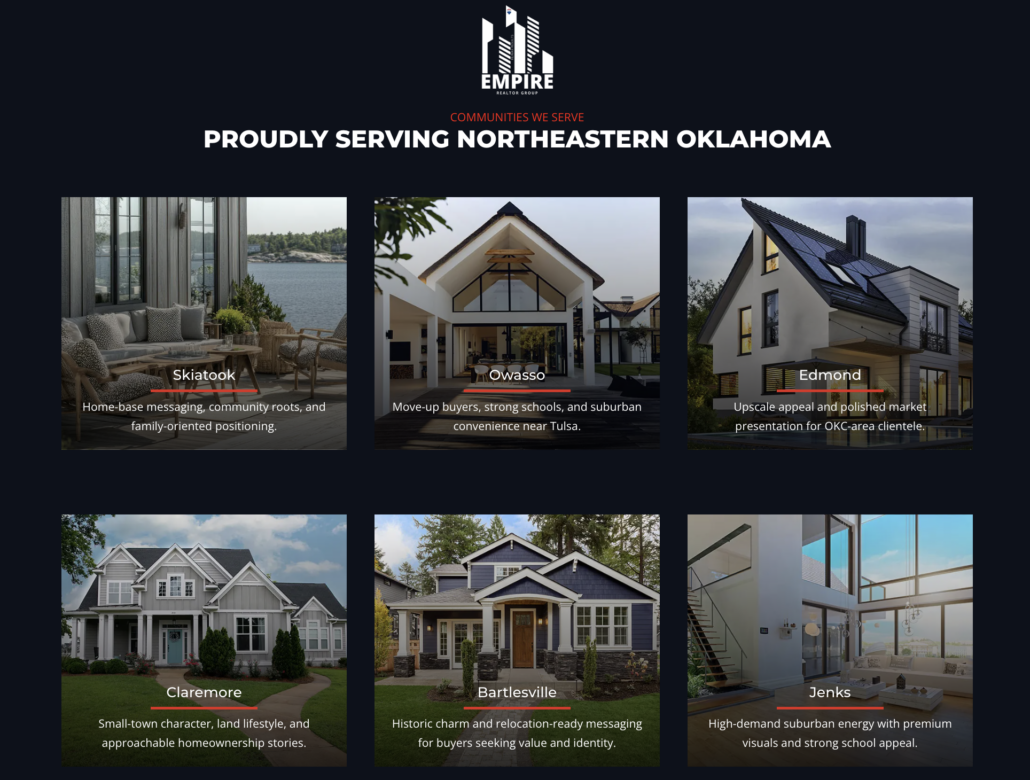
Are you missing an opportunity?
For most agents, market pages are the biggest missed opportunity on their entire real estate website. Why? Because they’re the pages that rank in Google for the searches buyers in your area are typing right now.
They’re the pages that get cited when someone asks ChatGPT or Gemini about neighborhoods in your city.
They’re the automated reports that keep your client database active and engaged. And they’re the pages most agents either haven’t set up or don’t fully understand.
If your website and property search are the engine, market pages offer continuous fuel. And with iHomefinder’s automation, it’s easy to design, use, and launch these pages for the benefit of your real estate business.
Most Agents Stop at Step One
A Market Page in iHomefinder is a saved search tied to a specific area. Think of a popular neighborhood, a zip code, a custom boundary you draw on the map, or a set of criteria like “golf course homes in Roseville.”
| At a glance: A market page is a dedicated page on your website for a specific area, neighborhood, or community you serve. You could target “Homes for Sale in Old Town Scottsdale” or “South Knoxville Real Estate” or “New Listings in Westlake Village.” |
Each market page pulls live MLS data for that area and presents it on a branded page on your site. Active listings, recently sold properties, price trends, open homes. They all get updated automatically, every day, without you having to constantly update or stay hands-on.
Creating your local content hub
But a market page isn’t just a list of homes. It’s a 24/7 content hub for that particular area that buyers are interested in.
You can use it to pull inventory stats, pricing trends, and show what homes are selling while others are sitting. You’ll access monthly market reports with real data.
And this is exactly the kind of information that buyers, sellers, and other agents actually look for and actually find useful.
Setting up your local market pages
Once you have iHomefinder, creating a new Market Page for your sales region is simple. In your IDX Control Panel, go to Markets and click Add New. Name the market, set your search criteria, and save.
Once you do, three reports are created automatically:
- Listing Report pages showing active and sold listings
- Open Homes pages showing upcoming open houses
- Market Report pages showing inventory, pricing, and trend data
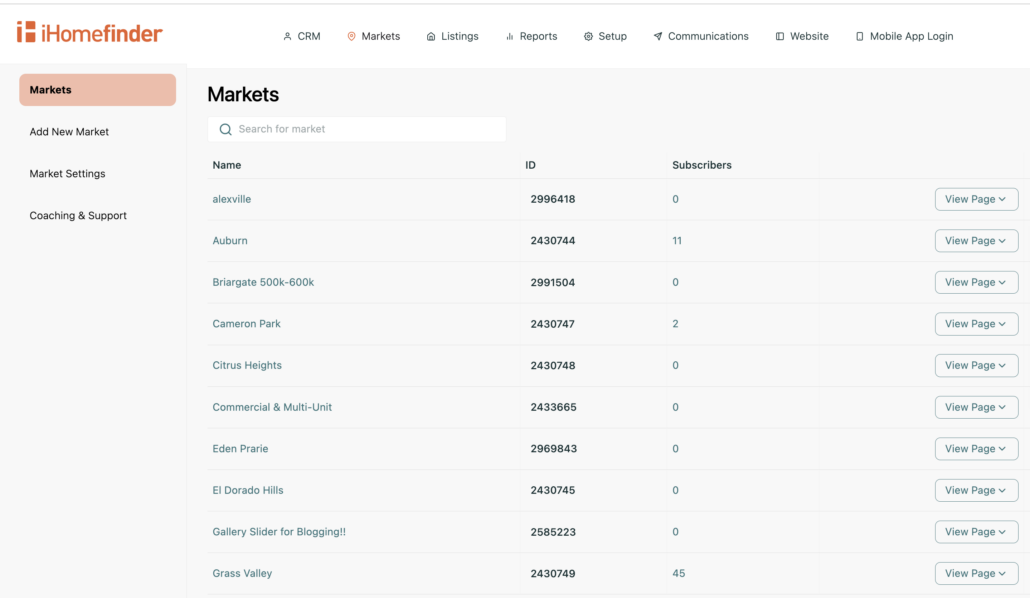
Each report stays updated using live MLS data. Each report also comes with a matching alert:
- Listing Alerts (daily)
- Open House Alerts (weekly)
- Market Report Alerts (monthly)
Visitors can subscribe directly from each market page, or you can add contacts yourself through the Control Panel.
Why Market Pages Matter More Than They Used To
Most agents think Market Pages are just an SEO perk. And since SEO is always changing—why bother making so many small, niche neighborhood pages and changes? But they’re not only useful for showing up in SERPs.
Market pages a visibility feature for you as an agent. They’re a lead generation must and a nurture engine all rolled into one.
The challenge is that most accounts never get far enough past setup to see those benefits kick in.
If you’re missing this crucial step in your iHomefinder workflow, here’s the motivation you need to get the ball rolling:
Buyers Are Searching for Places First, Not Agents
Buyers don’t search “best real estate agent in Phoenix.“
They search “homes for sale in Arcadia Phoenix” or “what’s the market like in Chandler Heights right now?”
Those are neighborhood-level searches, and the pages built to answer them are the pages that rank and reap results.
When your Market Page automatically appears for one of those searches, you’re showing up before the buyer has ever heard your name as an agent.
They land on current listings, local information, and usable market data. They subscribe for updates to know exactly what they’re getting into. Suddenly they’re in your database because the right page existed at the right moment.
AI Search Likes Specificity
This matters even more as search engine usage evolves.
AI-powered search pulls information from pages with specific, structured local content. A generic blog post about home buying competes with every national real estate website on the internet.
That means you’re more likely to lose out against the top contenders.
But a finished Market Page for a specific neighborhood competes with a handful of local agents, many of whom never completed the page in the first place. When you create and tend to your pages, you’re building authority—and the level of trust and expertise homeowners are looking for.
Your Hidden Nurture Engine Superpower
When it comes to Markets, most agents think they’re building static pages. But what they’re actually building is so much more—an automated follow-up engine that attracts buyers and sellers over time.
Every Market Creates Three Reasons to Come Back
Every Market automatically generates:
- Listing Alerts
- Open House Alerts
- Market Report Alerts
Set up five Markets and you suddenly have fifteen automated email campaigns running behind the scenes to attract buyers and keep them engaged.
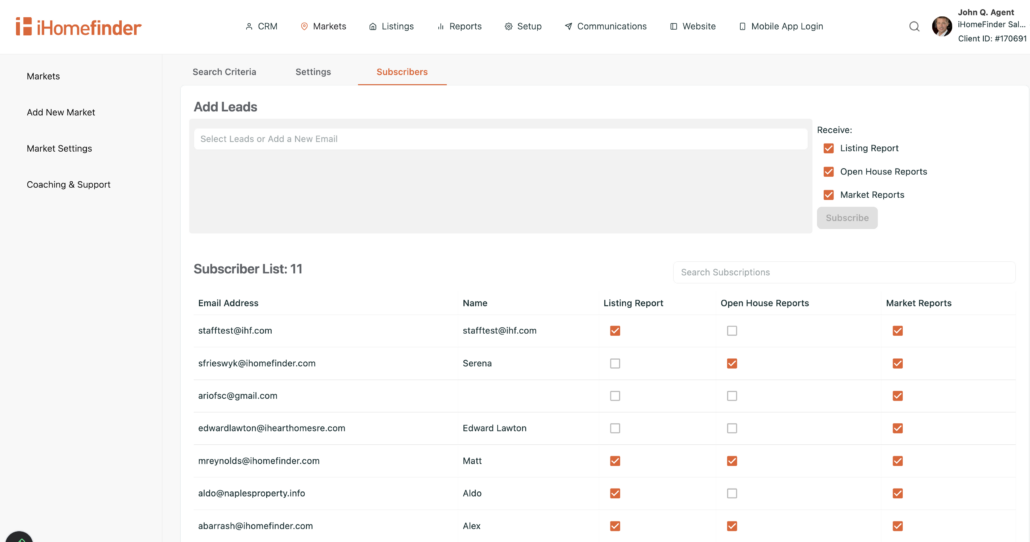
Every alert is branded to you as an agent. Every alert links back to your website (remember the foundation). Every click creates more behavioral data inside your real estate CRM—all centralized in iHomefinder.
This is the connection back to having a powerful real estate website. Market Pages don’t just attract visitors. They help create the recurring traffic loop that turns visitors into long-term contacts.
Finished Market Pages Win More Deals
Most marketing starts at its strongest and fades from there. Finished Market Pages tend to do the opposite: they gain value the longer they’re allowed to work.
Authority Compounds
A new Market Page starts with little search authority at first. But the underlying data keeps updating automatically: new listings, new sold properties, refreshed market statistics that stay fresh for clients.
Over time, search engines begin treating your market page as a reliable source for information about a specific area.
More visibility creates more traffic. More traffic creates more registrations. More registrations create more engagement.
The process feeds itself, and in turn, your business starts to boom.
Marketing Doesn’t Have to Reset Every Month
Many marketing strategies stop working the moment you stop paying. Ads go offline when the budget ends. Social media posts disappear from a person’s feed in hours.
A well-built Market Page can continue generating traffic and registrations months or years after it’s published because iHomefinder keeps doing the maintenance for you.
The pages keep working even when you’re focused on serving clients or running around town for your business.
That’s why finishing the pages you already have is often more valuable than creating something entirely new. Every completed Market becomes a long-term asset that can attract visitors, generate registrations, and create ongoing engagement inside your iHomefinder ecosystem.
Market Pages Are Becoming Full Community Pages
For years, most real estate websites treated community pages as glorified property searches: a headline, a list of listings, and not much else.
That’s becoming a problem.
Today’s buyers want context, not just inventory. Search engines want detailed local information. AI search tools want pages that answer real questions. A page that only displays listings has a harder time standing out than one that helps someone understand whether they actually want to live there.
That’s why iHomefinder is evolving Market Pages into more complete community resources.
In addition to live IDX listings and market data, community pages can include locally specific content about schools, commute patterns, neighborhoods, landmarks, housing styles, and the types of buyers who are most likely to enjoy living there.
Plus, built-in FAQ content helps answer the kinds of questions people are already asking in Google, ChatGPT, and AI-powered search tools.
The goal isn’t just to create another web page but to build a resource that helps visitors discover a community, evaluate whether it’s right for them, and stay connected through automated alerts and market updates.
In other words—you’re getting less “property search page,” more “local authority hub.”
| What Your iHomefinder Community Pages IncludeA finished community page combines automated market data with local expertise. Here’s what you can expect when you leverage this feature in iHomefinder:Hero section optimized around a specific city or neighborhoodLive IDX listings that update automaticallyCommunity information covering schools, lifestyle, commute, and local landmarksBuyer-focused guidance on who the area is best suited forLive market statistics and trendsListing alert signup tied directly to the MarketFrequently asked questions designed for modern AI search experiencesStrong calls to action that encourage visitors to connect with your teamThe result is a page that works harder for both search visibility and lead generation than a listings-only experience ever could. |
How To Tell If A Market Is Healthy
Before creating more Markets, take a look at the ones you already have set up in iHomefinder.
A healthy Market isn’t necessarily the one with the most listings or the most traffic. It’s the one that successfully turns local interest into ongoing engagement.
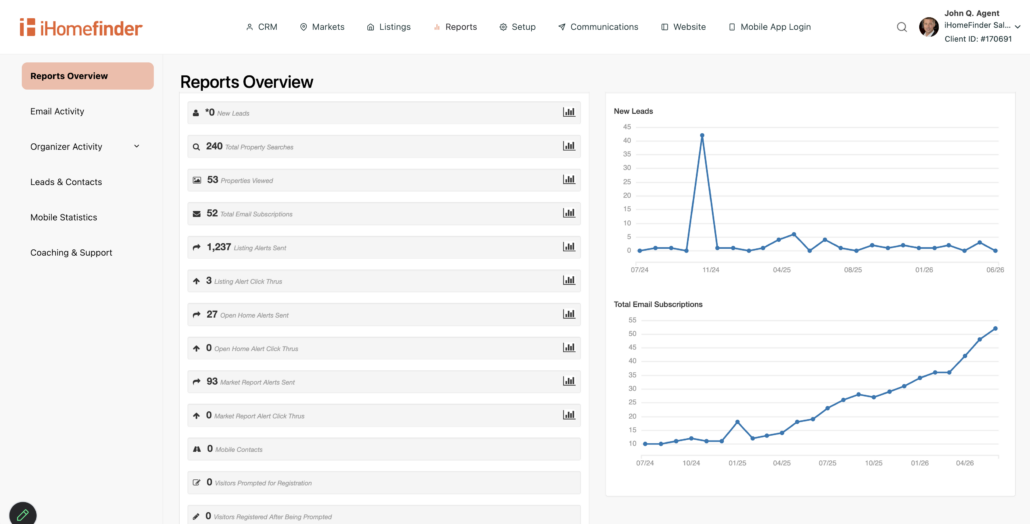
There are three signs to look for:
1. It Attracts Real Subscribers
Traffic is nice. Long-term subscribers are better.
A visitor who leaves after viewing a page may never come back. A visitor who subscribes to Market Alerts becomes part of an ongoing relationship powered by iHomefinder’s automated emails, market reports, and CRM tools.
Steady subscriber growth is a sign that your Market Page is attracting the right audience and giving them a reason to stay connected.
Every new subscriber expands the audience receiving your listings, market updates, and open house alerts without requiring additional manual follow-up from you.
2. It Generates Active Engagement
Subscribers tell you people are interested. Click-throughs tell you they’re engaged.
A healthy Market doesn’t just collect subscribers. It gives them reasons to come back.
Every click brings a contact back into your iHomefinder ecosystem, where they can browse listings, save favorites, update search criteria, and continue their home search journey.
Those interactions create valuable behavioral data that helps you understand who’s casually browsing and who’s becoming increasingly serious.
If alerts are going out but nobody is clicking, don’t ignore the signal. It’s often a sign that your Email Intro Text needs work, your market positioning isn’t specific enough, or your page isn’t providing enough local context.
3. It Builds Authority Over Time
This is the metric most agents don’t see.
Healthy market pages become stronger every month because iHomefinder keeps the underlying data current automatically.
New listings, sold properties, market statistics, and alert activity continually refresh the page without requiring ongoing maintenance from you.
Over time, that creates more opportunities for search visibility, more opportunities for registrations, and more opportunities for future engagement.
In other words, a healthy Market isn’t just generating results today. It’s becoming a more valuable business asset tomorrow.
The goal isn’t to create the most Markets. It’s to create Markets that are healthy enough to attract visitors, earn subscribers, and keep buyers coming back.
The Five-Minute Audit Every Account Should Do
If You’re Starting From Zero
Start with three to five neighborhoods you know exceptionally well.
Resist the temptation to create a Market for every city, subdivision, and zip code you serve on day one. Market Pages perform best when they combine live market data with genuine local expertise, and that’s much easier to do when you’re focused on areas you can actually speak about confidently.
Think about the questions buyers ask you most often. Which neighborhoods are growing? What school districts are most requested? Do specific areas offer the lifestyle your clients are searching for? Those are usually your best first community pages.
Specific and complete beats broad and empty every time.
If You Already Have Markets
Before creating anything new, review the Markets you already have.
Open each Market’s Settings tab and look at it through the eyes of a first-time visitor. Is there enough information for someone to understand why they should live there? Would an AI search engine find useful local context beyond the listings themselves?
Highlight schools, commute patterns, amenities, housing styles, and local landmarks. Update your email alerts to provide context instead of simply announcing new inventory. Confirm Listing Alerts, Open House Alerts, and Market Reports are all ready to go.
Many Markets already have the hard part done: the IDX data, reports, and automation are working. They just need a little local expertise layered on top.
If You Have Subscribers But No Clicks
Open Reports Overview and look for Markets generating email volume but little engagement.
In many cases, the problem isn’t the alert itself. It’s that subscribers aren’t seeing a compelling reason to click back to your website.
Review your Email Intro Text. Is it saying something useful about the market? Is it highlighting new inventory, pricing trends, or something buyers would genuinely care about? Then review the Market Page itself. Does it feel like a local resource, or just a list of properties?
Every click sends visitors back into your iHomefinder ecosystem, where they can browse listings, save favorites, update searches, and generate new behavioral data in your CRM. That’s why low click-through rates matter: they represent missed opportunities to turn passive subscribers into active prospects.
Where Market Pages Fit Into the Bigger System
Post 1 covered the foundation: your website and property search working together to turn visitors into contacts. Market Pages sit on top of that foundation.
They attract visitors who don’t know you yet.
Market Pages nurture existing contacts through automated alerts.
Plus, they create the behavioral data that powers Lead Intelligence, which we’ll cover next.
What To Do Right Now
- No Markets yet? Create your first three Markets. Start with neighborhoods you know well.
- Markets untouched since onboarding? Review the Settings tab for each one. Add webpage and email intro text. Confirm all alerts are enabled.
- Markets already finished? Review your Reports Overview. Look for gaps in coverage and opportunities to improve engagement.
__________________________________________________________
This is Post 2 of 6 in our Customer Education Series. Next up: Lead Intelligence—what your contacts are telling you through their behavior, and how to use it.