

Most real estate agents start out managing clients with spreadsheets, sticky notes, and a crowded inbox. It works—until it doesn’t. As your business grows, follow-ups slip, leads get lost, and it becomes harder to keep every deal moving forward.
That’s where a real estate CRM comes in. Built specifically for the way agents work, it helps you stay organized and automate busywork. Then, you can focus on what actually drives your business—building relationships and closing deals.
Quick Definition
A real estate CRM (Customer Relationship Management system) is software that helps agents and teams capture, organize, track, and nurture leads throughout the entire buying or selling journey. It centralizes contact data, automates follow-ups, and helps convert inquiries into closed deals.
What is a Real Estate CRM?
A real estate CRM is the system that manages your relationships, deals, and daily follow-ups in one place.
Instead of jumping between platforms and spreadsheets, you log into a single dashboard. This central hub gives you a complete, real-time overview of your entire real estate business.
Modern real estate CRMs offer advanced features. These include real-time client activity tracking, integration with other tools, and automatic data synchronization.

A high-quality platform typically handles the following tasks:
- Stores and organizes contact information: Keep names, phone numbers, email addresses, and personal details securely logged and easily accessible.
- Tracks lead activity and engagement: Monitor exactly when a prospect opens an email, clicks a link, or views a specific property listing.
- Automates emails, texts, and follow-ups: Set up sequences that automatically reach out to new inquiries instantly, ensuring nobody waits for a response.
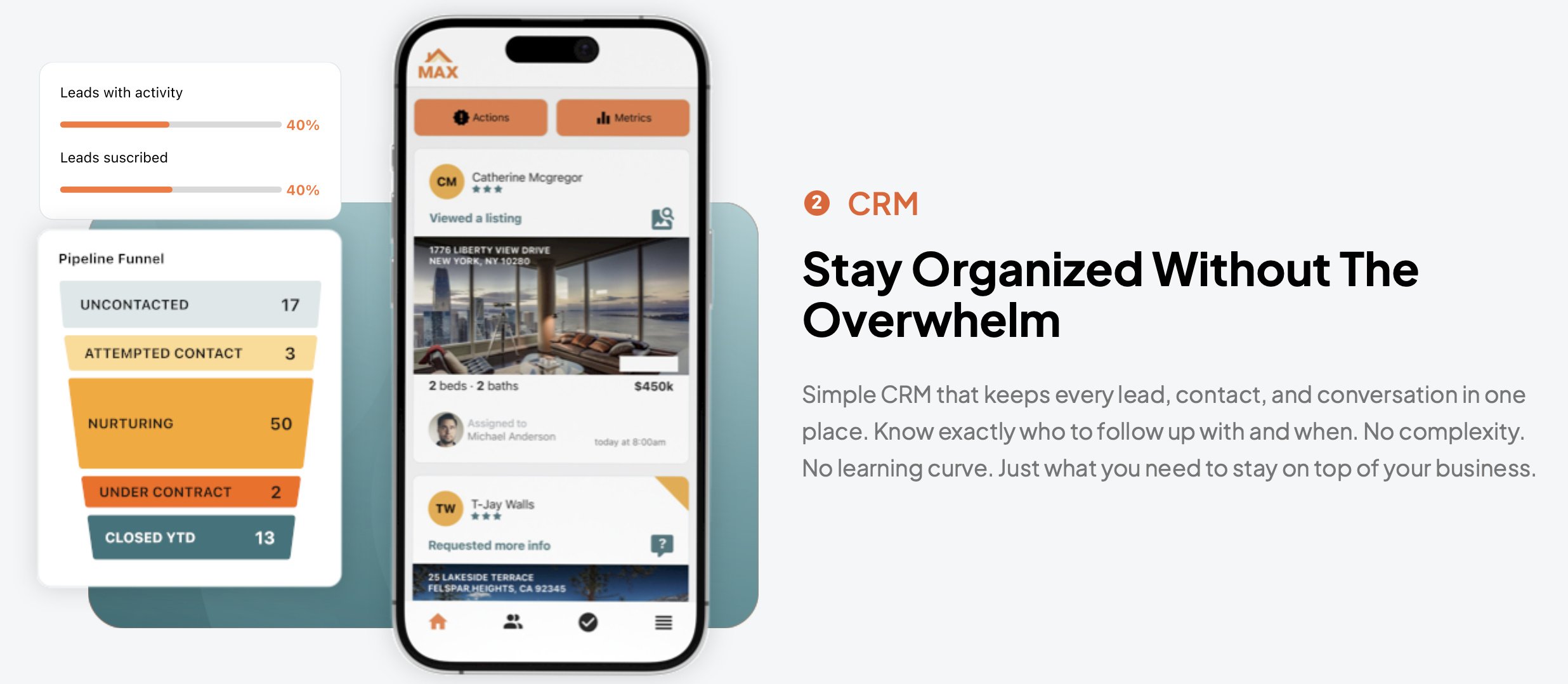
- Manages pipelines from inquiry to closing: Visually track where every single client is located within your sales funnel, from the initial contact to the final signature at the closing table.
- Integrates with your website and marketing tools: Connect directly to your property search features, lead capture forms, and digital advertising campaigns for a seamless flow of data.
- Centralizes lead management and improves customer relationships: CRM tools bring all your leads into one place, making it easier to nurture prospects and build stronger client connections.
Without a CRM, managing leads quickly becomes fragmented and inefficient.
What Does a Real Estate CRM Do?
A real estate CRM goes beyond storing contacts—it actively helps you generate, nurture, and convert leads. It acts as a digital assistant that works around the clock. A CRM also enables you to track and nurture future clients—potential buyers who may not be ready to transact immediately—by maintaining ongoing communication and building relationships until they are ready to move forward.
Lead Capture and Organization
The moment a potential buyer or seller expresses interest, the software goes to work. It eliminates the need for manual data entry, which is notoriously prone to human error. CRMs also help organize contacts efficiently, making it easier to manage client information and streamline communication.
- Captures leads from IDX websites, forms, ads, and referrals: Whenever someone fills out a contact form on your site or clicks on a Facebook ad, their information flows directly into your database.
- Automatically logs inquiries and property views: The system records exactly which homes caught a prospect’s eye, providing you with valuable context before you even make the first phone call.
- Tags and segments leads by behavior and criteria: Automatically group your contacts based on their budget, desired neighborhoods, or timeline to move, allowing for highly targeted marketing down the road.
- Contact management for tracking interactions and improving communication: Easily organize detailed client profiles, track every interaction, and filter contacts by various criteria to build stronger relationships and increase efficiency.
Lead Nurturing and Follow-Up
Most real estate leads are not ready to transact on day one. They require consistent, helpful communication over weeks or months to build trust.
- Sends automated email and text sequences: Keep your brand top-of-mind by delivering valuable market updates and property alerts without having to hit “send” manually.
- Creates automated task reminders for calls and check-ins: Never forget a follow-up. The system uses task reminders to help agents stay organized, ensuring timely follow-ups and keeping deals moving forward by automating notifications and deadlines related to client interactions and lead management.
- Tracks engagement (opens, clicks, searches): Know exactly who is actively engaging with your content so you can prioritize your daily outreach efforts toward your warmest prospects. Managing client communications through the CRM ensures timely and effective interactions, helping you engage clients and close deals more efficiently.
Pipeline and Deal Tracking
Knowing the status of your current business is vital for predicting your future income.
- Visual sales pipeline for buyers and sellers: See your entire business at a glance using intuitive drag-and-drop boards that represent different stages of the transaction process, providing a visual overview of ongoing transactions.
- Tracks deal stages and timelines: Monitor critical dates, inspection periods, and closing schedules to ensure nothing slips past a deadline.
- Keeps all communication in one place: Store every email thread, text message conversation, and call note under a single contact record, providing total clarity for you and your team members.
Pipeline management tools help agents track prospects through different stages and optimize the sales process for better conversion rates.
Automation and Workflows
Efficiency is the key to scaling your operations. Management tools within a CRM help agents organize, streamline, and oversee their sales, client information, and administrative tasks, making it easier to stay on top of daily responsibilities. By automating repetitive tasks, you free up hours of your week.
- Assigns leads automatically (round robin, rules-based): For teams and brokerages, the software instantly routes new inquiries to the right agent based on zip code, price point, or a simple rotating schedule.
- Triggers follow-ups based on behavior: If a past client suddenly starts viewing listings on your website again, the system can automatically send them a personalized re-engagement message.
- Reduces manual admin work: Eliminate the tedious task of copying and pasting data between different applications.
These features allow agents to stay consistent and responsive—two factors that directly impact conversion rates, especially since these systems are specifically designed to handle real estate workflows such as MLS integrations and transaction tracking.
Why is a Real Estate CRM Important?
Real estate is a relationship-driven business, but scaling those relationships requires systems—not memory. Building client relationships is a core purpose of using a CRM, as it enables real estate professionals to manage, personalize, and strengthen every interaction with clients.
Implementing a dedicated platform provides several massive advantages for your daily operations:
- Never lose or forget a lead: Every inquiry is captured and stored safely, ensuring that the marketing dollars you spent to acquire that lead are never wasted.
- Respond faster to inquiries: Speed to lead is critical in real estate. Automated initial responses guarantee that prospects hear from you instantly, greatly increasing your chances of winning their business.
- Nurture client relationships and improve customer relationships automatically: Use personalized communication like holiday greetings, home anniversary emails, and market reports. Keep past clients engaged, build trust, and foster long-term loyalty.
- Stay organized across dozens (or hundreds) of contacts: Maintain total clarity and control over your database, regardless of how large it grows.
- Improve conversion rates and close more deals: Consistent follow-up naturally leads to higher conversion metrics, directly boosting your bottom line.
A real estate CRM is important because it ensures every lead is tracked, followed up with, and nurtured until they are ready to transact.
Why Agents Can’t Scale Without a CRM
You might be able to manage ten active clients using a notepad. But what happens when a successful marketing campaign generates fifty new inquiries in a single week? As real estate companies and real estate agencies scale, CRM systems become essential. You can better manage increasing lead volume, streamlining workflows, and improving client communication.
When agents attempt to grow their business without proper technology, several painful bottlenecks emerge:
- Spreadsheets and inboxes don’t scale: These basic tools lack automation, tracking capabilities, and visual pipelines, making them incredibly difficult to maintain as your contact list expands.
- Missed follow-ups lead to lost deals: If you fail to call a prospect back promptly, they will simply reach out to the next agent on their list.
- Inconsistent communication hurts trust: Sending sporadic, disorganized messages makes you look unprofessional and damages your credibility with potential clients.
- No visibility into pipeline performance: Without clear data, you cannot accurately forecast your income or identify which marketing channels are actually generating a positive return on investment.
- Hard to manage teams or assign leads: As you hire buyer’s agents or administrative assistants, you need a centralized system to delegate tasks and monitor performance. A CRM supports team collaboration, allowing a real estate team to share updates, assign tasks, and improve efficiency throughout the transaction process.
Without a CRM:
- Leads fall through the cracks
- Follow-up is inconsistent
- Growth stalls
With a CRM:
- Leads are tracked automatically
- Follow-ups happen on time
- Business scales predictably
Key features to Look For in a Real Estate CRM
Essential real estate CRM features support client management, communication, and data analysis. This connection helps real estate professionals manage client information, enhance customer experience, and track performance metrics. When evaluating different software options, ensure the platform includes the specific tools required to manage property transactions effectively.
- IDX integration and property search tracking: This connects your database directly to the local Multiple Listing Service. MLS allows you to monitor exactly what homes your clients are viewing.
- Automated lead capture and registration: The system should effortlessly pull contact details from your website forms and landing pages.
- Stores and organizes contact information
- Creates detailed client profiles: Comprehensive client profiles enhance contact management, customer service, and sales forecasting.
- Integrates with your website and marketing tools
- Tracks advertising metrics: Measure the effectiveness of your advertising campaigns and refine your client engagement strategies.
- Email and SMS automation: Robust communication tools are non-negotiable for building multi-touch drip campaigns.
- Automates email marketing campaigns: Set up and automate email marketing within the CRM to nurture leads and streamline communication.
- Behavioral tracking (saved searches, listing views): Insights into a lead’s online activity help you understand their urgency and specific preferences.
- Reporting and analytics: Clear dashboards provide insights into your conversion rates, agent performance, and overall business health.
- Manages and automates marketing campaigns: Use the CRM to manage, automate, and personalize marketing campaigns to improve client engagement.
The best real estate CRM connects directly to your website and marketing tools to create a seamless lead flow.
Real Estate CRM vs. Generic CRM: What’s the Difference?
While general CRMs exist, real estate-specific platforms are built around how agents actually work. Generic sales software is often designed for B2B (business-to-business) companies selling software or physical products.
These platforms require massive amounts of custom configuration to make them suitable for selling houses. Customer relationship management software offers industry-specific features that streamline client management, sales, and marketing efforts.
A dedicated real estate platform, on the other hand, comes pre-configured with the tools, terminology, and integrations—including property management and commercial real estate features—that agents use every single day.
| Feature | Real Estate CRM | Generic CRM |
|---|---|---|
| IDX integration | Yes | No |
| Property tracking | Yes | Limited |
| Lead behavior insights | Advanced | Basic |
| Automation for listings | Yes | No |
| Built for agents/teams | Yes | No |
A real estate CRM is designed specifically to convert property inquiries into clients. There are many CRM solutions available, each tailored to different real estate needs, including both residential and commercial sectors.
How a Real Estate CRM Works Alongside Your Website
Your CRM and website should function as one connected system—not separate tools. When these two assets integrate, they form a powerful lead generation engine that works continuously in the background of your business.
Using a cloud-based CRM provides real-time access to your data from any device and ensures robust data protection for your client information.
- Captures leads directly from your IDX website: When a visitor requests a showing or saves a favorite property, their details instantly populate your database.
- Tracks property searches and saved listings: You gain immediate visibility into the specific neighborhoods, price points, and architectural styles your prospects are researching.
- Triggers follow-ups based on user behavior: If a lead views the same property three times in one day, the system can automatically send an email asking if they would like to schedule a private tour.
- Syncs contact data in real time: Ensure your records are always perfectly up to date, eliminating the need to manually export and import CSV files.
- Automatically synchronizes CRM data across platforms: All CRM data, including client interactions and property updates, is kept current and accessible, supporting accurate analytics, segmentation, and personalized marketing.
A real estate CRM works with your website by capturing and tracking visitor activity, then automatically nurturing those leads over time.
Real Estate CRM Security
In the real estate industry, protecting client data is non-negotiable. Real estate professionals manage everything from contact details to financial information—making security a critical part of any CRM.
The best platforms are built with safeguards like encryption, two-factor authentication, and regular backups, so you can manage client relationships with confidence. Strong security not only keeps your data protected, it builds trust with clients and reinforces your professionalism.
Real Estate CRM Mobility
In real estate, you’re rarely at your desk. You’re at showings, on calls, and moving between clients—so your CRM needs to move with you. Mobile access lets real estate professionals pull up client data, respond to leads, and update deals from anywhere.
That flexibility makes it easier to stay organized and keep client relationships moving forward. Instead of waiting to get back to the office, you can act in real time.
Real Estate CRM Support
Switching to a new real estate CRM can feel like a big lift—but the right support makes all the difference. The best platforms offer onboarding, clear documentation, and responsive help when you need it.
For real estate professionals, that means fewer roadblocks and faster progress. You can get your system set up correctly, manage client data with confidence, and keep client relationships running smoothly from day one.
Who Should Use a Real Estate CRM?
A CRM isn’t just for large teams—it’s essential at every stage of growth. Regardless of how many years you have held your license, implementing the right software will profoundly impact your daily efficiency. Choosing the right CRM system or your brokerage’s CRM depends on your specific business needs, workflow, and goals.
- New agents building their pipeline: Establish professional habits from day one and ensure every single contact you meet is properly nurtured.
- Solo agents managing multiple clients: Multiply your personal effectiveness through automation, making it feel like you have a full-time assistant.
- Teams assigning and routing leads: Create a fair, transparent, and highly accountable environment for distributing incoming business among your buyer’s agents.
- Brokerages scaling operations: Gain high-level visibility into company-wide performance, conversion metrics, and overall marketing ROI.
- The right CRM can help a real estate business grow: By streamlining client management, automating tasks, and supporting lead generation, the right CRM system enables your business to expand efficiently.
- High-volume agents running paid marketing: Protect your advertising budget by ensuring every internet lead receives immediate, automated follow-up.
Selecting the right CRM for your workflow is crucial, as the effectiveness of a real estate CRM depends on your business size, structure, and growth objectives.
Common Mistakes Agents Make Without a CRM
Many agents try to delay using a CRM—but that often costs them deals. Trying to save a few dollars a month on software subscriptions usually results in thousands of dollars in lost commission revenue. Implementing CRM systems effectively is crucial to avoid these costly mistakes, as proper integration into your workflow ensures you capture every opportunity and maintain strong client relationships.
When you operate without a centralized database, you are highly susceptible to several critical errors:
- Relying on memory or notes instead of systems: Human memory fades, and sticky notes get thrown away. Important details about a client’s motivation or timeline are easily forgotten.
- Missing follow-ups with warm leads: When you don’t have automated reminders, it is incredibly easy to let days or weeks slip by without contacting a highly qualified prospect.
- Failing to track lead sources: Without proper data, you cannot determine if your Facebook ads, Zillow leads, or direct mail campaigns are actually generating a profitable return.
- Using disconnected tools that don’t sync: Forcing data manually between an email provider, a spreadsheet, and a calendar creates friction and wastes immense amounts of time.
- Losing visibility into their pipeline: When you cannot see your current deals clearly, you experience massive anxiety about where your next commission check will come from.
How to Choose the Right Real Estate CRM
The best CRM is one that fits your workflow and supports long-term growth. With so many options available on the market, it is important to evaluate software based on your specific business model and technical comfort level.
Use this simple checklist when evaluating potential platforms:
- Does it integrate with your IDX website? A seamless connection to your property search data is absolutely vital.
- Does it automate follow-ups? Look for robust email and text messaging campaigns that you can easily customize.
- Can it scale with your business? Ensure the platform allows you to add team members, adjust lead routing rules, and handle higher volumes of data as you grow.
- Does it provide clear reporting and insights? You need easy-to-read dashboards that display your conversion rates and pipeline value.
- Does it support advanced marketing strategies through automation? Check if the CRM can enhance your marketing strategies by automating campaigns. You can also track analytics or integrate your marketing efforts.
- Is it easy to use daily? Software is useless if the interface is too complicated for you to navigate consistently.
Build a Real Estate Business that Scales
A real estate CRM is not just a contact database. It’s the engine that powers your lead generation, follow-up, and conversion strategy. Leveraging a CRM is key to achieving real estate success. It enables effective organization, client management, and automation for long-term growth.
With iHomefinder, you get a fully integrated system that combines indexable IDX listings, lead capture tools, and CRM functionality in one platform. That means you can attract, manage, and convert leads without juggling multiple tools.
Start building a real estate business that scales with iHomefinder. Schedule your demo today.
FAQs
What is a real estate CRM in simple terms?
A real estate CRM is a tool that helps agents manage contacts, track leads, and automate follow-ups to close more deals.
Do real estate agents need a CRM?
Yes. Without a CRM, it is difficult to track leads, stay organized, and consistently follow up—especially as your business grows. A CRM also helps agents securely manage and protect customer data.
What is the best CRM for real estate agents?
The best CRM is one that integrates directly with your website, automates follow-ups, and tracks lead behavior in real time. Platforms like iHomefinder combine CRM functionality with indexable IDX websites, giving agents built-in lead capture, behavior tracking, and automated nurture tools—all in one system designed to convert traffic into clients.
How does a CRM help real estate agents make money or drive business?
A CRM helps agents convert more leads into clients by ensuring timely follow-up, better organization, and consistent communication.