

You pay for a lead. You call. No answer. You send a follow-up email. Still nothing.
Meanwhile, that same person might be hearing from three other agents who bought their contact information, too.
It’s a frustrating way to build a real estate business, especially when your business depends on a steady stream of purchased leads.
But buying leads isn’t the only option when you want to grow.
You can generate real estate leads through your own website, local search visibility, existing relationships, and consistent follow-up. And unlike a list of purchased contacts, these are channels you can continue building over time. Plus—only you own them.
In this guide, we’ll cover easy steps you can take to get started.
Can you generate real estate leads without buying them?
There’s no doubt. Real estate agents can generate leads without purchasing them from third-party providers. Referrals, organic search, social media, local partnerships, and your existing contact database can all help you connect with potential buyers and sellers.
That doesn’t mean every strategy is completely free. You might still need to invest in a website, CRM, or marketing tools.
The difference is that you’re building your own lead-generation channels instead of paying someone else for access to potential clients.
Some strategies, like reconnecting with past clients, can lead to conversations quickly. Others, like search engine optimization (SEO), take longer to build momentum.
But when you hit the ground running, it means your business doesn’t depend entirely on your next lead purchase.
8 ways to generate real estate leads without buying them
Some of your best lead-generation opportunities may be hiding in plain sight: a past client who hasn’t heard from you in months, a buyer browsing listings on your website, or a local homeowner searching for advice about selling.
The challenge is recognizing where interest already exists and giving those potential clients a reason to connect with you.
1. Turn your real estate website into a lead-generation tool
Your website should be part of a strong online presence that attracts clients. It’s not just a pretty place to display your headshot, contact information, and a few featured listings. It should help visitors find what they’re looking for and give them a reason to stay connected.
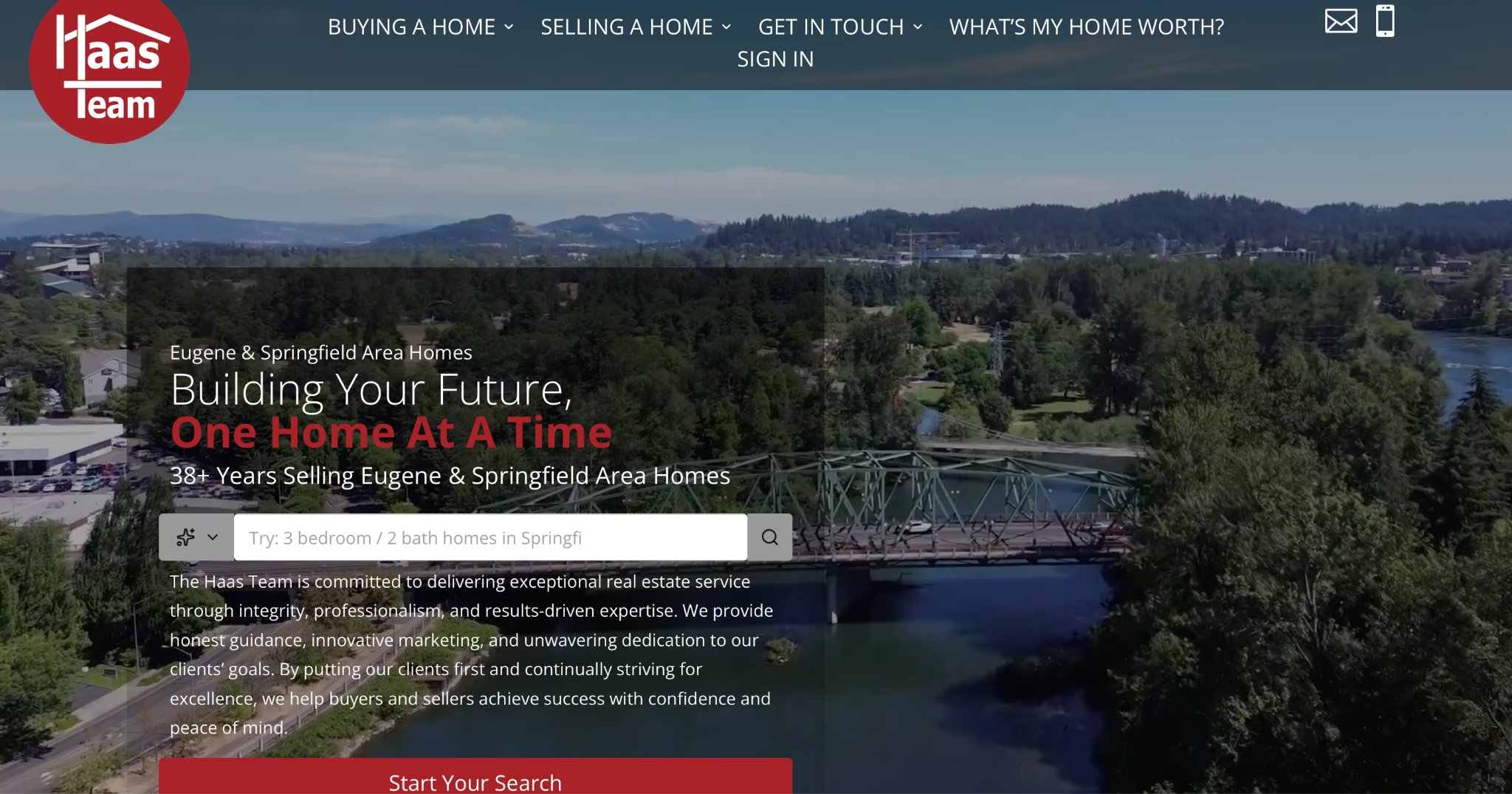
Start by opening your website as if you’re a buyer who has never heard of you.
Can you search for homes? Explore neighborhoods? Find useful information about the local market? Is there an obvious next step when you find something interesting?
A few features can make a difference:
- IDX property search: Let visitors explore current listings without leaving your website.
- Neighborhood and market pages: Give buyers useful information about the areas they’re researching.
- Saved searches and listing alerts: Help visitors keep track of properties that match their criteria.
- Lead capture opportunities: Make it easy to request information, ask a question, or use landing pages with a lead magnet that offers a valuable resource in exchange for contact information.
Each of these features gives visitors a way to move from browsing your website to taking a more meaningful next step.
Pro Tip: iHomefinder brings these capabilities together, helping you turn property searches and website activity into opportunities to connect with potential clients.
2. Improve your visibility in local search results
When someone searches for a real estate agent in your city, does your business show up?
What about when they search for homes in a neighborhood you serve?
Local SEO helps potential clients find your business when they’re researching agents, properties, and communities in your area.
Start with a few basics:
Optimize your Google Business Profile: Complete your profile with accurate business details, photos, and relevant information about your services.
Keep your information consistent: Make sure your contact details, website, and business hours are accurate wherever your business appears online.
Request client reviews: Ask satisfied buyers and sellers to share their experiences on Google.
Create local content: Build useful pages about the neighborhoods you serve, including housing trends, amenities, and available properties.
Check your mobile experience: Make sure visitors can easily navigate your website, search listings, and contact you from their phones.
And remember, not everyone searching for real estate information is ready to hire an agent.
Someone searching for “homes for sale in [Neighborhood]” or “moving to [City]” may still be exploring their options.
Give them useful information now, along with a way to browse listings or learn more about the area. That creates an opportunity to connect before they’re ready to schedule a showing or choose an agent.
| Local SEO doesn’t have to start with an expensive marketing campaign. As Myles Anderson, co-founder and CEO of BrightLocal, explains, “It’s all about getting the foundations right.” That means keeping your Google Business Profile accurate, making your website useful to local visitors, and consistently collecting genuine client reviews. |
Try this: Search for your business and a few relevant local real estate terms. Look at what appears, then identify one thing you can improve this week.
3. Publish content that answers buyer and seller questions
You know those questions clients ask that make you think, “I’ve explained this a hundred times”?
Stop answering them just once.
Every time you explain closing costs, talk a seller out of an unnecessary renovation, or help a buyer compare two neighborhoods, you’re sitting on content someone else is probably searching for.
And here’s where you have an advantage: You actually work in the market you’re writing about.
You know which neighborhoods buyers keep asking about, what sellers tend to underestimate, and which parts of the buying process leave people scratching their heads. Put that knowledge to work.
Instead of publishing another generic “10 Tips for Buying a Home” article that could have been written by anyone, get specific:
- What First-Time Homebuyers Should Know About Buying in [City]
- How Much Does It Really Cost to Sell a Home in [County]?
- [Neighborhood A] vs. [Neighborhood B]: What Buyers Should Consider
- Why Are Homes Taking Longer to Sell in [City]?
And don’t stop at blogging. Turn a useful answer into a short video, share it on Instagram, or use it to start a conversation with your email subscribers.
National real estate websites can explain how buying and selling works. Only you can explain what actually happens in your market, based on what you’ve seen firsthand.
That’s the kind of content worth putting your name on.
4. Ask for referrals before you need them
Your past clients already know what it’s like to work with you. And those relationships can be one of your best sources of new business.
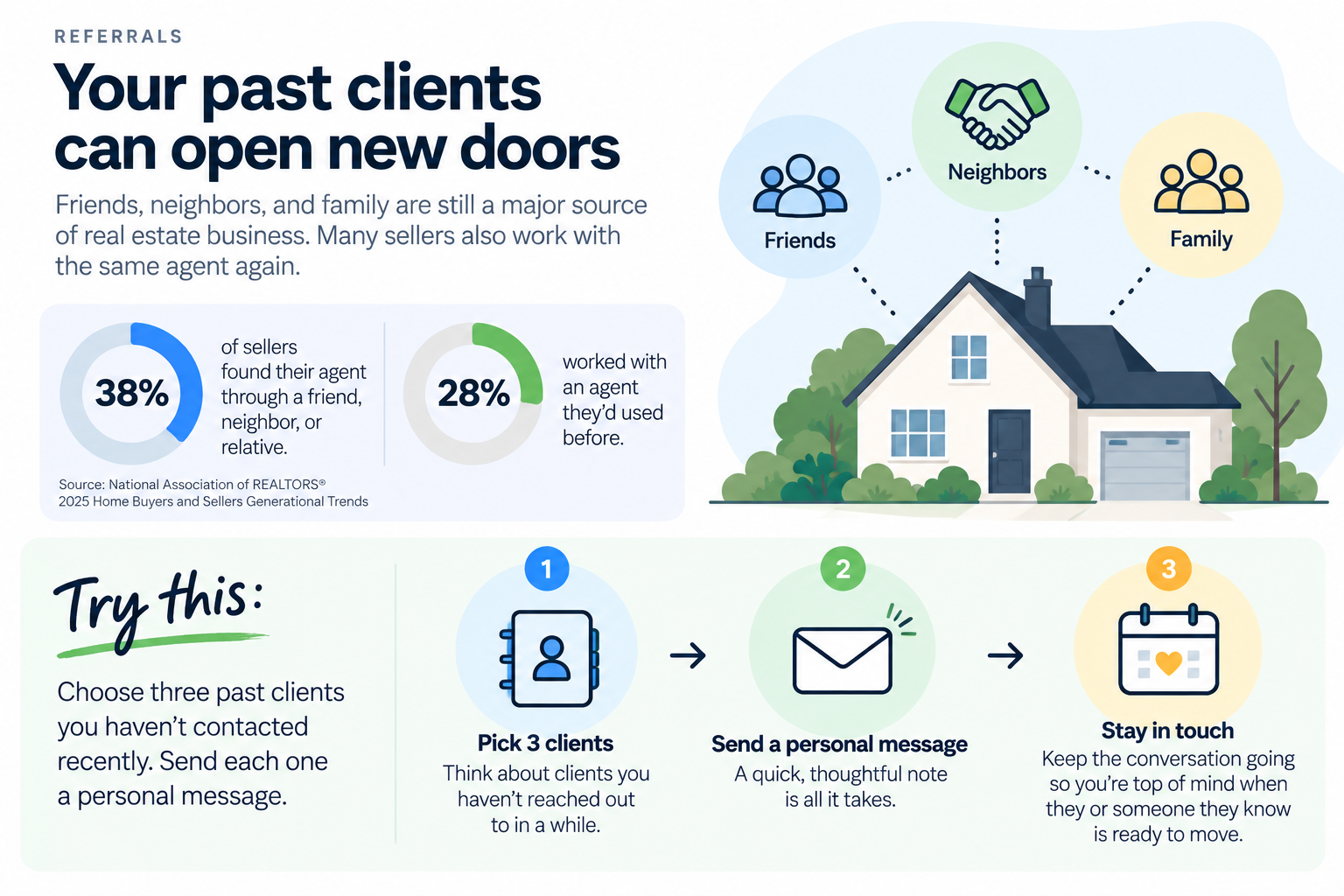
According to the National Association of REALTORS®, 38% of sellers found their agent through a friend, neighbor, or relative, while another 28% worked with an agent they’d used before.
But that doesn’t mean you’ll automatically come to mind when a friend mentions they’re thinking about moving. Stay in touch.
You don’t have to send elaborate newsletters or constantly ask for referrals. A short, thoughtful message can go a long way.
Try this: Choose three past clients you haven’t contacted recently. Send each one a personal message. No mass email. No generic sales pitch.
5. Use social media to start conversations
If your entire social media strategy consists of posting a listing photo, adding “Just listed! 🏡” and hoping someone calls, you’re probably leaving opportunities on the table.
People don’t follow real estate agents just to see houses they could find on Zillow.
They want to know what it’s like to live in a neighborhood, whether now is a good time to buy, and what they should know before making one of the biggest financial decisions of their lives.
Give them something worth paying attention to. For example, you could:
- Answer the awkward questions: Is offering $20,000 below asking price insulting? How much money does a first-time buyer actually need?
- Show what locals know: Walk through a neighborhood and point out the parks, restaurants, and everyday details that listing photos miss.
- Explain what’s happening in your market: Are homes sitting longer? Are sellers offering concessions? Tell people what you’re seeing.
- Share the behind-the-scenes stuff: Talk about a common inspection surprise, a negotiation lesson, or something you wish every buyer knew before touring homes.
And when someone comments or sends you a message, don’t treat it like another engagement metric.
Talk to them one-on-one.
Answer their question. Ask what they’re looking for. If you’ve written a helpful neighborhood guide or have relevant listings on your website, send them the link.
Pick a platform where your audience spends time, share what you know, and make it easy for people to continue the conversation. A thousand views might look impressive. But one genuine conversation with someone planning to move could be worth a lot more.
6. Build relationships with local businesses and professionals
You know who else talks to people who are buying, selling, or moving?
Mortgage lenders. Contractors. Home inspectors. Moving companies. Even the owner of that coffee shop everyone visits when they’re house hunting.
These people are already part of your local real estate market. And some of them could become valuable referral partners.
But don’t show up to a networking event, hand out 30 business cards, and expect your phone to start ringing. Give people a reason to remember you.
Here are a few ways to make those connections more useful:
- Team up with a mortgage lender to host a first-time homebuyer workshop where people can ask questions without feeling pressured to buy.
- Create a moving guide featuring local movers, contractors, utility providers, and businesses that new residents might need.
- Collaborate with a local business on a neighborhood video or social media post that introduces potential buyers to the community.
- Build relationships with home service professionals who can help your clients prepare a property for sale or settle into a new home.
And remember that referrals should go both ways. If a contractor consistently does excellent work, recommend them when appropriate. If a local business owner needs real estate advice, be willing to help before there’s a commission on the table.
One important note: Keep referral relationships compliant with applicable laws, including RESPA where relevant, and your brokerage’s policies. Don’t assume you can exchange referral fees or other compensation simply because another business sends you a client.
7. Reconnect with leads already in your database
Before spending another hour trying to attract strangers to your website, open your CRM.
There’s a good chance someone in there was interested in buying or selling six months ago and simply wasn’t ready.
Maybe they wanted to wait until their lease ended. Maybe they couldn’t find the right house. Maybe they were thinking about selling but wanted to finish a few renovations first.
Those people didn’t necessarily lose interest. Life just got in the way.
Look for contacts you haven’t spoken with recently and review what you know about them.
Then give them a reason to respond. Instead of sending another “Just checking in!” email, try something specific:
- For a buyer who paused their search: “A few homes have come on the market in the neighborhood you liked. Want me to send you the ones worth a look?”
- For a homeowner considering selling: “You mentioned wanting to wait until fall. Are you still thinking about listing, or have your plans changed?”
- For someone who requested a home valuation: “I’ve been watching recent sales in your area. Would an updated estimate be helpful?”
See the difference?
You’re not asking someone to remember who you are or explain their situation all over again. You’re picking up a conversation you’ve already started.
A real estate CRM makes this easier by keeping contact details, previous conversations, and follow-up tasks in one place. And you don’t need to tackle your entire database this afternoon.
Find five people. Read their notes. Send five thoughtful messages. You might be surprised how many opportunities are sitting in a database you’ve already spent time building.
8. Create a follow-up routine you can actually stick to
Here’s an uncomfortable question: How many potential clients have reached out to you and never heard back?
Not because you didn’t care. Because you were at a showing, negotiating an offer, driving across town, or dealing with the hundred other things that happen during a typical workday.
It happens.
But the buyer who requested information about a property doesn’t know how busy you are. They just know they’re waiting for an answer.
And if another agent responds first, you may never get the chance to have that conversation.
Your follow-up process needs to work even when your calendar doesn’t cooperate.
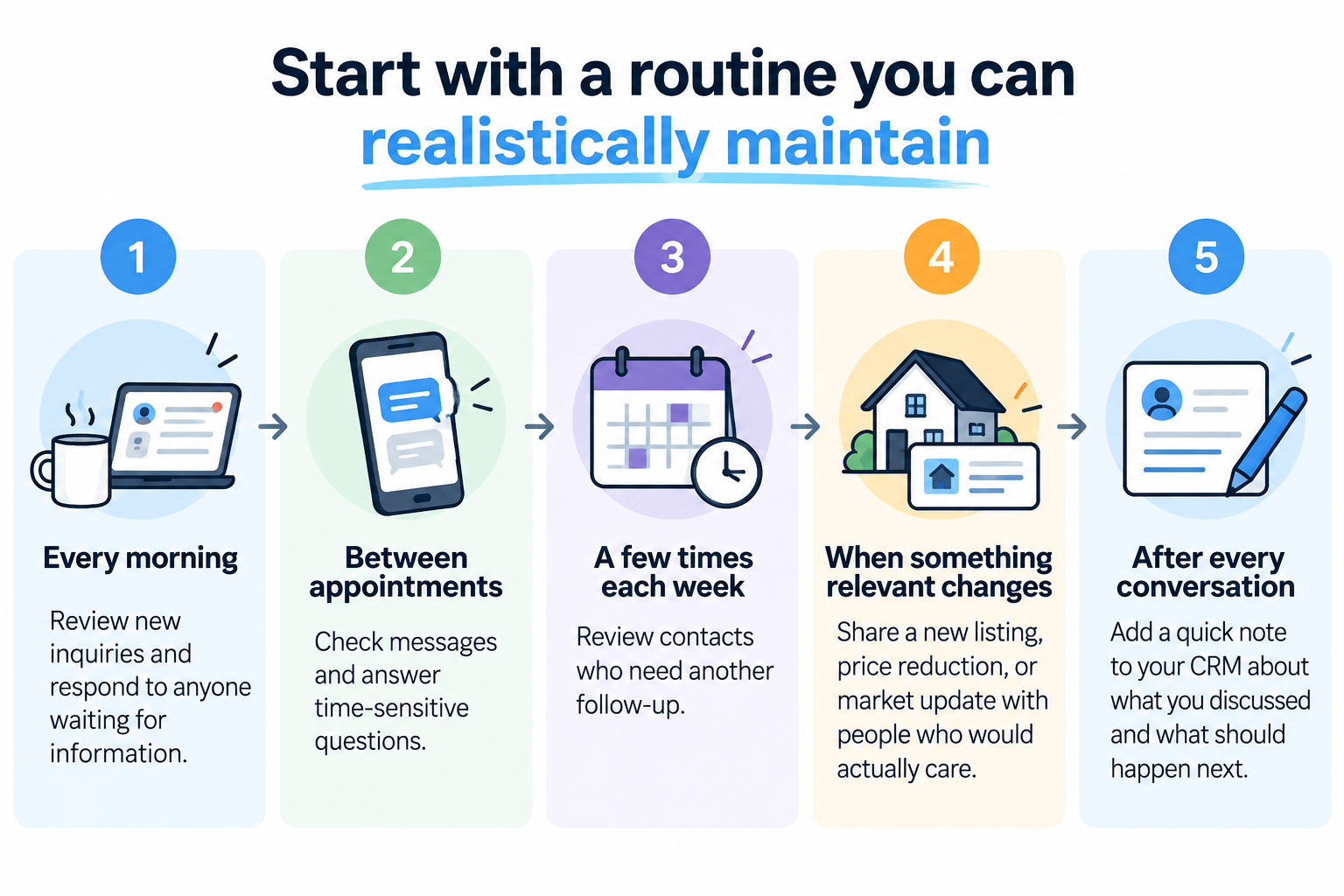
Start with a routine you can commit to:
- Every morning: Review new inquiries and respond to anyone waiting for information.
- Between appointments: Check messages and answer time-sensitive questions.
- A few times each week: Review contacts who need another follow-up.
- When something relevant changes: Share a new listing, price reduction, or market update with people who would actually care.
- After every conversation: Add a quick note to your CRM about what you discussed and what should happen next.
You can automate some of the busywork, too.
Listing alerts can notify buyers when matching properties become available. Email campaigns can share useful resources over time. CRM reminders can help you remember that someone wanted to reconnect in October.
But here’s where agents can get lazy. Automation isn’t a substitute for paying attention.
If someone has spent the last three weeks looking at four-bedroom homes in a particular school district, they probably don’t need your generic monthly newsletter about national housing trends.
They need to know when a relevant property hits the market, whether the asking price makes sense, and what their next step should be.
Big picture: Use automation to remember the details and handle repetitive tasks. Use your own judgment to make the follow-up worth opening.
Try this: Find five leads in five minutes
Before spending money on new leads, take five minutes to see what opportunities are already sitting in your CRM.
You might have buyers who paused their searches, homeowners who weren’t quite ready to sell, or people who expressed interest but never heard from you again.
Set a timer for five minutes and look for:
- Two buyers who went quiet. Find contacts who previously searched for homes or saved listings but haven’t been active recently. Check whether new properties match their original criteria.
- Two potential sellers. Look for homeowners who mentioned selling in the next six months or requested information about their home’s value. Their plans may have changed.
- One lead who never took the next step. Find someone who requested property information, attended an open house, or filled out a contact form but never scheduled a conversation.
Once you’ve identified five people, review their previous activity and decide what would make a useful follow-up.
Don’t send everyone the same “Just checking in!” message. A buyer might appreciate a new listing in their preferred neighborhood, while a potential seller might be interested in recent home sales nearby.
You won’t turn every contact into a client. But you might restart a conversation that’s worth more than another purchased lead.
Which real estate lead-generation strategies should you start with?
Not every strategy will produce results on the same timeline. Some help you start conversations with people you already know. Others build visibility so new buyers and sellers can find you.
Here’s how they stack up:
| Strategy | Best for | Barrier to entry |
| Website and IDX search | Capturing interest from website visitors | Requires planning setup |
| Local SEO | Building long-term search visibility | Ongoing effort for organic growth over time |
| Blogging | Attracting buyers and sellers researching questions | A few hours per post, plus time to schedule and publish |
| Referrals | Reconnecting with existing relationships | Easy to start today |
| Social media | Building awareness and conversations | Easy to start today |
| Local partnerships | Expanding your community network | Ongoing effort as you network |
| CRM re-engagement | Finding opportunities in existing contacts | Easy to start today |
| Consistent follow-up | Turning inquiries into conversations | Easy to start today |
If you’re not sure where to begin, choose one activity from each category.
For immediate opportunities: Review your CRM and reconnect with people who have already expressed interest.
For long-term growth: Improve your website or create one useful piece of local content that potential clients can find through search.
That gives you something to work on today without losing sight of the business you’re trying to build.
Build a real estate lead source you own
Here’s the problem with buying leads: You’re paying for an introduction to someone who might already be talking to three other agents.
Building your own lead sources takes more work upfront, but it gives you something worth keeping: relationships with people who found you, trust your expertise, and know where to turn when they’re ready to make a move.
With iHomefinder, you can give buyers a place to search listings, capture inquiries, and keep conversations going with built-in CRM and automated follow-up tools.
Ready to make your website work harder for your real estate business?
Explore iHomefinder’s real estate lead-generation tools.
Frequently asked questions about generating real estate leads
How can new real estate agents get leads for free?
New agents can start by building local relationships, attending community events, improving their Google Business Profile, publishing useful content, connecting with people in their existing networks, and offering to host open houses.
These activities don’t require purchasing individual leads, although they do require time and consistent effort.
What is the best way to generate real estate buyer leads?
Start by making it easier for buyers to find you while they’re researching homes and neighborhoods. Publish useful local content, offer IDX property searches and listing alerts on your website, and ask past clients for referrals. Then follow up with information that matches each buyer’s interests. The best approach depends on your local market and the buyers you’re trying to reach.
How can real estate agents generate seller leads without paying for them?
Create content that answers common seller questions, share local housing market updates, maintain relationships with past clients, and offer opportunities to request home valuations. Referrals and community relationships can also help you connect with homeowners considering a sale.
How long does it take to generate organic real estate leads?
It depends on the strategy. Reconnecting with existing contacts might lead to conversations immediately, while blogging and SEO can take months to build meaningful visibility. Consistency matters more than expecting quick results from every channel.