
Real estate teams now spend more on technology than ever before. From CRMs and IDX websites to AI scoring tools and automation platforms, tech is now one of the biggest operational expenses across brokerages, teams, and solo agents. Real estate technology is transforming the real estate business by streamlining operations, enhancing client engagement, and speeding up transactions. But here’s the challenge: very few can confidently say whether their investment is actually paying off.
To grow sustainably, real estate businesses need a clear, practical way to evaluate the return on investment (ROI) of their tools. New software solutions are constantly emerging, making it important for real estate businesses to assess their impact and ensure they align with business goals. The right framework helps teams eliminate tech bloat and increase adoption.
Let’s break down exactly how to measure what’s working—and spot what isn’t.
Introduction to Property Technology
Property technology, or proptech, is revolutionizing the real estate industry by introducing innovative solutions that streamline operations, boost property values, and enhance the overall customer experience.
Traditionally, the real estate sector has been slow to embrace new technologies, but that’s changing rapidly as real estate professionals and property owners recognize the benefits of digital transformation.
Today, proptech encompasses everything from artificial intelligence that powers smarter property searches, to digital marketing tools that reach more potential buyers, to virtual property tours that allow clients to explore homes from anywhere. These advancements help real estate professionals deliver better service, increase transparency, and stay competitive.
Investment Strategies
Successful real estate investing goes beyond simply buying and selling properties—it requires a deep understanding of market trends, consumer preferences, and the latest investment strategies. Real estate professionals are increasingly turning to big data, machine learning, and emerging technologies to make more informed decisions. By analyzing vast amounts of real estate data, investors can identify potential buyers, predict shifts in consumer demand, and optimize their portfolios for maximum property values.
Incorporating smart home features and focusing on energy-efficient properties can also attract modern buyers and boost long-term returns. Staying ahead of technology trends ensures that your investment strategies remain relevant and effective in a dynamic real estate market.
What Does ROI Really Mean for Tech and Real Estate?
ROI is simply a measure of whether the money you spend on technology delivers enough value to justify the cost.
ROI = (Return – Cost of Investment) ÷ Cost of Investment
But in tech and real estate, “return” doesn’t only mean closed deals. It also includes:
- More high-quality leads
- Higher lead-to-client conversion
- Faster follow-up
- Time saved through automation
- Lower dependence on paid lead sources
- Better client experience and retention
- Automating tasks to improve efficiency and reduce repetitive tasks
When the right tools work together — especially your IDX website and CRM — ROI becomes easier to measure, track, and improve. Automating tedious processes is a key way technology delivers ROI in real estate, as it streamlines workflows, improves efficiency, and eliminates repetitive or labor-intensive steps.
ROI Pillars Every Real Estate Team Should Measure
Real estate transactions, time to close, and lead quality. You’ve got your eye on a little bit of everything. But if you’re not sure where to start when it comes to measurement, here are the key areas to watch.
1. Lead Quality and Lead Conversion
Lead generation means nothing if it doesn’t turn into closed deals. Your IDX website and CRM should help you improve key conversion metrics:
- Website visitor → lead
- Lead → appointment
- Appointment → client
- Client → closed transaction
A real estate website that features high quality photos and virtual tours can significantly improve lead quality and conversion rates by providing an engaging online platform for buyers and sellers.
If you’re generating traffic but not capturing leads, or capturing leads but not converting them, your ROI is suffering.
Higher IDX engagement = higher lead quality.
2. Agent Productivity and Time Savings
Technology should give agents more time to sell — not more admin tasks.
Measure:
- Response time to new leads
- Number of follow-ups completed
- Tasks automated vs. done manually
- The time agents spend inside the CRM
- How many new conversations agents generate per week
Property management software can help property managers automate routine tasks such as maintenance requests and vendor management, streamlining operations and freeing up more time for client-focused activities.
3. Marketing Performance and Cost Efficiency
Your real estate tech should make your marketing more efficient, not more expensive.
Track:
- Cost per lead (CPL)
- Cost per appointment
- Cost per closed deal
- Organic traffic from IDX listing pages
- SEO growth
An online platform with popular features and easy access can significantly boost your marketing performance and attract more leads by streamlining user experience and making information readily available.
A strong IDX website reduces your reliance on expensive portals — and improves long-term ROI.
4. Client Experience and Engagement
Happy clients come back. And they refer.
Measure:
- Property alert engagement
- Repeat visits to your IDX search
- Saved searches and favorite listings
- Email and SMS open rates
- Long-term nurture response
These signals show how well clients connect with your digital ecosystem. Leveraging resident data allows you to personalize engagement and provide relevant neighborhood insights, while promoting energy efficiency through smart property management solutions can further enhance client satisfaction and experience.
5. Revenue Growth and Pipeline Health
Your tech should make it easier to grow your business.
Key indicators:
- Total volume per agent
- Average sales price
- Pipeline size and pipeline velocity
- Number of active high-intent leads
- Deals completed per marketing dollar spent
Tracking rent payments and the performance of rent properties, along with monitoring housing market trends, can provide deeper insights into revenue growth and pipeline health.
If revenue is rising without increasing your technology spend, your ROI is strong.
Comparison: Where Real Estate Teams Typically Lose ROI
| Area | ROI Leak | Why It Happens | How to Fix It |
|---|---|---|---|
| Lead Follow-Up | Slow responses | Manual tasks slow agents down | Automation + instant alerts |
| CRM Adoption | Low usage | Tools are too complex | Simplify workflows and training |
| IDX Website | Poor mobile speed | Buyers bounce before converting | Use a mobile-first IDX provider |
| Data Visibility | Disconnected systems | Agent decisions lack context; challenges integrating data from multiple sources | Integrate IDX + CRM |
| Marketing Spend | Over-reliance on portals | Costs rise, quality varies | Improve organic IDX traffic |
Real Estate Market Analysis—What’s Happening Now?
In the modern real estate market, thorough market analysis is essential for real estate professionals to make informed decisions and stay ahead of the competition.
Leveraging multiple data sources—such as real estate listings, property records, and consumer preference data—enables real estate companies to spot emerging market trends and tailor their strategies accordingly.
Advanced tools like virtual reality and augmented reality are now being used to showcase properties in immersive ways, giving potential buyers a realistic sense of space and features before ever setting foot inside. This not only enhances the customer experience but also helps real estate professionals present properties more effectively and close deals faster.
How to Measure ROI from Your IDX Website
Your IDX website is one of the most overlooked sources of ROI in real estate. A high-performing IDX site:
- Attracts organic traffic
- Captures high-intent leads
- Generates repeat engagement
- Sends powerful behavioral insights to your CRM
Track these IDX metrics:
- Search activity: listings viewed, pages visited
- Registration rate: how many visitors become leads
- Saved searches and favorites: strong intent signals
- Email alert opens and clicks: repeat visits
- Mobile performance: bounce rate + load speed
If any of these numbers are weak, ROI suffers — even if your traffic is high.
How to Measure ROI from Your CRM and Automation Tools
Your CRM either boosts conversion or drains time. You can track:
- Lead response times
- Number of automated follow-ups sent
- Lead conversion by source
- Agent adoption and usage
- AI-scored leads vs. manually selected leads
Your CRM should make agents faster, not busier. If it isn’t improving response times or follow-up consistency, your ROI is low. Additionally, it’s crucial to protect sensitive information and enhance security when using CRM and automation tools to safeguard client and company data.
How to Build a Real Estate Technology ROI Dashboard (Simple Framework)
Use these steps to evaluate your entire tech stack:
- List every tool you pay for
- Document the annual cost
- Assign each tool to one of the five ROI pillars
- Identify the KPIs each tool should improve
- Track those KPIs weekly or monthly
- Cut or replace tools that don’t deliver measurable impact
This shifts your tech decisions from “nice-to-have” to “ROI-driven.”
Why Tech ROI Improves Dramatically with Integration
Most ROI loss stems from tools not working together. When your IDX, CRM, automation, and AI tools all work seamlessly:
- Data is richer
- Follow-up is faster
- Lead scoring becomes more accurate
- Agents have complete context for every conversation
- Leaders get clean, actionable reporting
Disconnected tools keep you guessing. Integrated systems keep your pipeline full.
Why iHomeFinder Delivers Strong, Measurable ROI
Upgrading your tech stack only pays off if the tools work together and deliver real business outcomes. iHomeFinder does this by improving lead quality, agent efficiency, and client engagement — all measurable ROI drivers.
Property management companies and commercial real estate teams can also leverage these tools to streamline operations and achieve measurable ROI. Here’s how:
IDX and CRM are unified, eliminating data silos
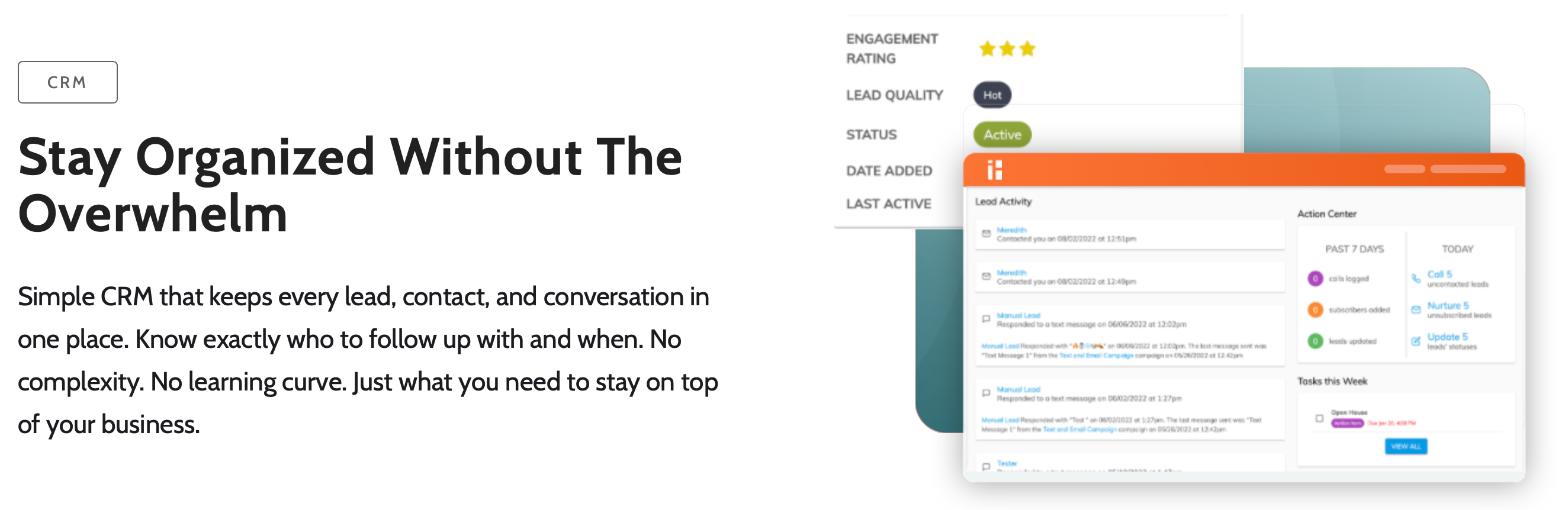
Most real estate teams lose ROI because their tools don’t talk to each other. iHomeFinder connects your IDX website, lead capture, and CRM in a single system. This gives agents complete visibility into what each lead is viewing, saving, and searching for.
This means:
- Every property view, search, save, and alert is instantly recorded
- Agents always see the full activity history before reaching out
- Ao more duplicated contacts or manual work.
Major win: With unified data, your follow-up becomes smarter, faster, and far more relevant — a major ROI booster.
Mobile-first IDX experiences generate more registrations
According to recent data from the National Association of Realtors (NAR), over 70% of home buyers use a mobile or tablet device during their home search. This shows just how important mobile IDX performance is for capturing leads.
If your site is slow or poorly designed, they won’t convert. iHomeFinder’s IDX is engineered for speed, clarity, and responsiveness, keeping buyers on your site longer. This leads to:
- Lower bounce rates
- More leads captured per visitor
- More return visits
When your website works flawlessly on every device, every marketing dollar delivers more value.
AI-powered lead scoring identifies buyers who are ready to act
Not all leads deserve the same time investment. iHomeFinder’s AI highlights the ones showing the strongest buying signals—repeat views, price sensitivity, search frequency, and more. This gives your agents:
- a ranked list of the best opportunities
- insight into who needs outreach today
- less time wasted on low-intent browsers
Prioritizing the right leads increases conversion without raising your ad spend.
Automated property alerts bring visitors back again and again
Property alerts are one of the highest-ROI real estate marketing tools. iHomeFinder automates these alerts so buyers:
- Get updates instantly
- Return to your website frequently
- Rely on your brand for their search
These repeat touches are essential for turning casual browsers into loyal clients — and it all happens automatically.
Agent-friendly workflows increase adoption
Even the best tools fail without team adoption. iHomeFinder is designed to be simple, intuitive, and surprisingly agent-friendly, even for users who aren’t tech-savvy. This results in:
- Higher CRM usage
- Better follow-up consistency
- Faster onboarding
When adoption goes up, ROI rises across the entire organization.
Team dashboards make performance measurable
You can’t improve what you can’t measure. iHomeFinder provides clear dashboards showing:
- Response time
- Top-performing agents
- Hottest leads
- Marketing source performance
This transparency helps teams coach smarter, allocate leads more effectively, and scale with confidence.
Better ROI without increasing ad spend
iHomeFinder helps you generate more leads from the traffic you already have. Instead of buying more leads or expanding your advertising budget, you improve the efficiency of your existing funnel — the most cost-effective way to grow.
See how iHomeFinder delivers measurable ROI across your IDX, CRM, and automation tools.
What Does the Future of Real Estate Investing Look Like?
The future of real estate investing is moving quickly, and much of that change is driven by how people now search, communicate, and make decisions. New technologies like blockchain, IoT, and modern mobile apps are reshaping everything from property management to building operations, giving both professionals and clients more transparency and efficiency than ever before.
As more buyers and renters turn to online platforms and mobile devices for their property search, real estate companies need to focus on delivering simple, intuitive digital experiences.
Staying aware of key technology trends and being willing to adapt will help real estate professionals stay competitive, meet client expectations, and build long-term success in a rapidly evolving industry.