

Scaling Your Real Estate Business: Is Your Real Estate Website Platform Holding You Back?
Growth changes everything in real estate. As you add more agents to a team, expand your reach, and increase the volume of listings, the systems that once worked can start to strain. Many website builders are great for getting started, but they aren’t always built to keep up as teams grow.
A scalable real estate website is designed to keep supporting real estate agents as their business evolves. It can handle more traffic, listings, and leads without slowing down or forcing a rebuild. If your site feels harder to manage as you grow, it may be time to rethink whether your current platform is truly built for long-term success.
Why Growing Teams Outgrow Their Real Estate Website Platform
When teams hit a growth ceiling, they often blame their marketing strategy or their agents. However, the issue is often technological.
Platforms designed for individual agents or hobbyists aren’t engineered to handle the complexities of a multi-agent organization. Brokers and larger teams benefit from one platform that connects website, CRM, and marketing tools, allowing for seamless management and efficient scaling.
Growth exposes limitations in platforms that weren’t built for teams. Here is how that typically happens:
- Increased volume: As you drive more traffic and feature more listings, entry-level servers and databases slow down. Slow load times kill conversion rates.
- Lead capture tools: As traffic grows on your own website, basic contact forms aren’t enough. Scalable real estate websites need advanced lead capture tools—such as saved searches, listing alerts, and behavior-based registration—that engage visitors and convert interest into actionable leads automatically.
- Agent management: You need sophisticated ways to distribute leads. A simple “contact us” form that goes to a single inbox doesn’t work when you have ten agents waiting for assignments.
- SEO expectations: As you invest in content, you need a platform that structures data in a way Google respects. Many basic builders rely on technologies that search engines struggle to index.
- Workflow bottlenecks: Manual data entry—like moving a lead from your email to your CRM—becomes impossible to sustain at scale. Modern real estate website platforms connect directly with CRMs and offer support services to help brokers and agents manage their sites efficiently.
Customizable templates and integrated support are also key features for brokers and teams looking to scale, ensuring that their real estate website platform can grow with their business needs.
What Teams Actually Need from a Real Estate Website
To move past these bottlenecks, you need to shift your focus from “web design” to “web infrastructure.” A pretty homepage won’t help you manage a roster of 20 agents, but the right backend architecture will.
A scalable real estate website for growing teams should support:
- Indexable property pages or custom landing pages: Every listing should be a unique URL on your domain that Google can read and rank.
- Reliable search at scale: Users expect Zillow-like speed. Your search function shouldn’t lag, even with thousands of local listings in the feed.
- Advanced lead capture: You need more than a generic contact form. You need registration prompts, saved search capabilities, and tools like market reports that encourage visitors to trade their contact info for value, helping you generate leads and keep clients engaged.
- Automated routing: The platform must be able to send specific leads to specific agents based on price point, zip code, or round-robin rules.
- Deep integrations: Your website cannot live in a silo. It must talk to your CRM and marketing tools instantly. Integration with popular CRMs like Follow Up Boss is essential for seamless lead management.
- Growth analytics: You need to see exactly which pages, listings, and sources are driving your revenue so you can double down on what works. Professional platforms often include AI tools, interactive home valuations, and mortgage calculators to further support lead generation and client engagement.
A user-friendly CMS and CRM integration are crucial for teams to manage website updates, nurture leads, and generate leads efficiently.

Website Builder vs. Growth-Ready Platform
It is easy to confuse a “website builder” with a “platform.” While they may look similar on the surface, they serve different purposes.
Website builders generally focus on aesthetics and ease of use. They are fantastic for getting a brochure-style site up quickly. The best website builder options for real estate agents, such as Placester, AgentFire, and Agent Image, make it super easy to launch a site with pre-designed templates that can be customized to match your branding and lead generation goals.
Many real estate website builders also include built-in SEO tools to enhance your search engine visibility. They prioritize drag-and-drop design elements, font choices, and stock photography.
Growth-ready platforms prioritize what happens under the hood. They focus on:
- SEO Architecture: Ensuring the site structure helps you rank.
- Automation: Removing manual tasks from your daily to-do list.
- Integrations: Connecting your tech stack into a cohesive ecosystem.
- Long-term flexibility: allowing you to add features without tearing the house down.
These platforms are an excellent choice for agents who want to build trust with clients and position themselves as experts in their market by maintaining a polished, professional website.
Scalability depends less on how a site looks—and more on how it works behind the scenes.
Choosing the best website builder is key to ensuring both ease of use and long-term growth.
Have we met yet? Introducing iHomefinder Max for real estate agents.
How IDX Impacts Real Estate Website Scalability
The engine of any real estate website is the Internet Data Exchange (IDX). This is the feed that pulls listing data from the MLS to your site.
Main point: An IDX plugin is a vital tool for integrating MLS data and enhancing property search functionality, providing features like mapping, CRM, and SEO capabilities. How IDX is implemented defines your ceiling for growth.
Poor IDX implementation relies on “framing” or subdomains. Effectively, you are cutting a hole in your website and showing a view of another website through it. Search engines like Google generally ignore the content inside these frames. This limits your SEO potential, hurts page load performance, and often restricts how you can capture leads.
For a real estate website to be scalable, it requires:
- Listings on your domain: The property data must live on your URL, not a third-party link.
- No Iframes: Content must be native to the page so search engines can credit you for the keywords.
- Automatic updates: The feed must refresh constantly with real-time data sync from the local MLS to ensure property pricing and availability are always accurate, without manual intervention.
- Multi-market support: As you expand into new territories, your IDX needs to handle multiple MLS feeds simultaneously.
Many real estate website builders offer IDX integration to display property listings directly from MLS databases. IDX/MLS integration is essential for displaying current and accurate listings, supporting scalability, and ensuring your website remains competitive.
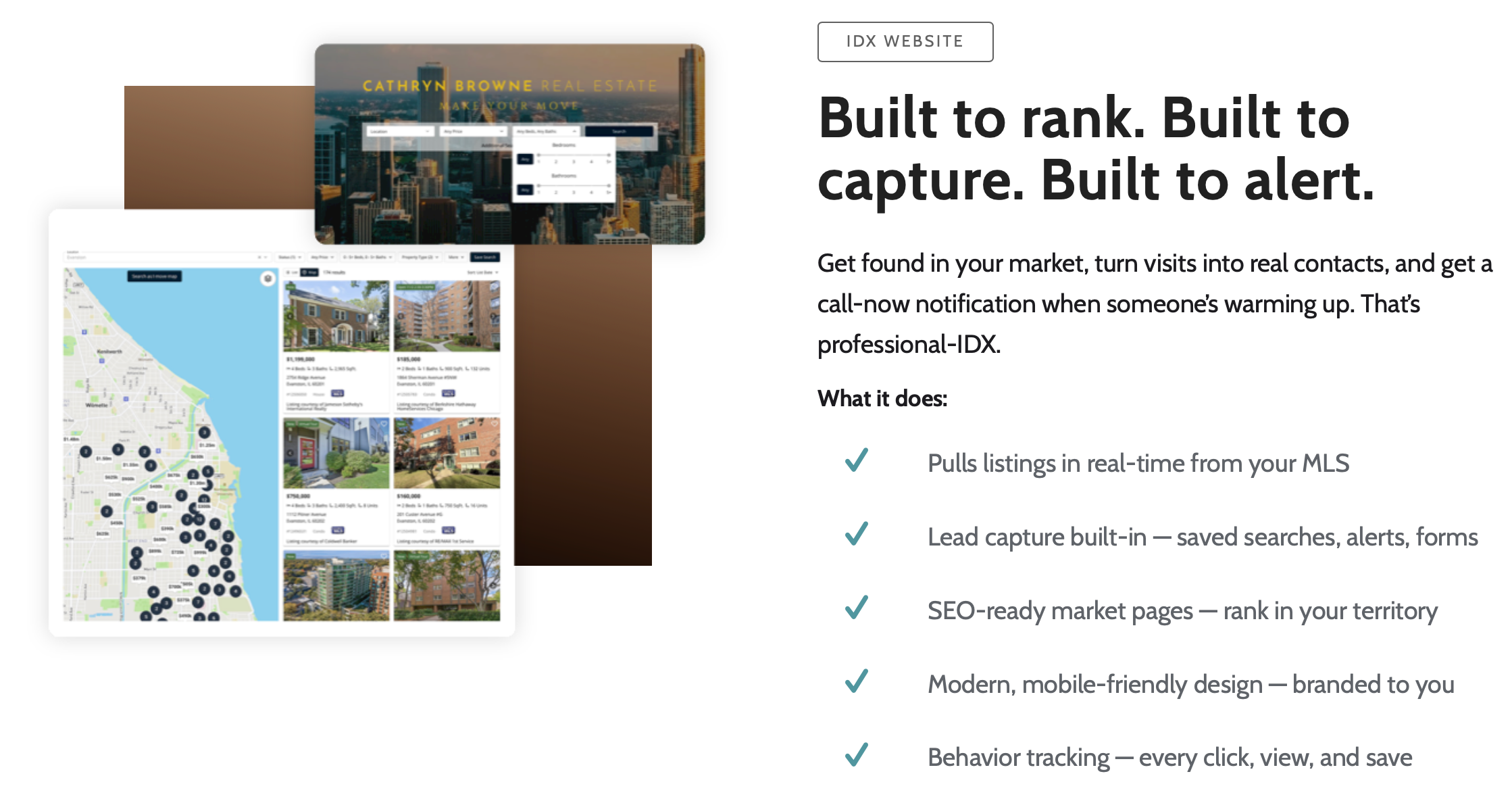
iHomefinder Supports Scalable Real Estate Websites
iHomefinder is designed specifically to solve the scalability issues that growing teams face. As one platform, it connects your website, CRM, and marketing tools, enabling seamless communication and growth for real estate professionals.
It bridges the gap between flexible website design and powerful property search technology. With CRM integration, teams can connect with leads from various sources, manage contacts, and nurture relationships efficiently. Using a personal platform like iHomefinder also ensures you retain your lead database and SEO history, even when changing brokerages.
Indexable IDX Content to Grow Traffic
With iHomefinder, listings and search results live directly on your domain. This creates thousands of indexable pages that help boost your authority with search engines. Instead of sending SEO value to a portal, you keep it for yourself, supporting long-term discoverability.
Lead Capture for Teams
The platform moves beyond basic contact forms. It includes registration rules, saved search capabilities, and property alerts. More importantly, it uses behavior-based triggers. If a lead looks at the same house three times, your system knows about it. This creates an environment built to convert repeat visitors into clients.
Automation to Reduce Manual Work
As your team grows, you cannot afford to manually update listings or forward emails. iHomefinder handles MLS updates automatically and routes leads to agents or teams based on your rules.
Automation helps connect website data with CRMs for efficient lead management. It also integrates with leading CRMs and email marketing tools, ensuring that no data is lost in the handoff.
Platform Flexibility
Perhaps most importantly, iHomefinder works where you work. Its IDX plugin integrates seamlessly with platforms like WordPress, offering extensive customization options and adding essential property search functionalities, MLS data integration, and marketing tools to your real estate website.
Whether you use WordPress, Wix, Squarespace, or a custom site, the technology integrates smoothly. WordPress users, in particular, benefit from a vast ecosystem of real estate-specific themes and plugins, providing limitless customization—though it comes with a steeper learning curve.
This supports growth without forcing a complete website rebuild every time you want to upgrade your look.
Real Estate Wbeiste Checklist for Growing Teams
If you are evaluating your current setup or looking for a new vendor, use this checklist as a decision tool. If you answer “no” to more than one of these, your platform may be stifling your growth.
- Can listings be indexed by search engines? (Are they on your root domain?)
- Does IDX performance hold up under traffic? (Does search stay fast?)
- Are leads routed automatically? (Can you assign to specific agents?)
- Does it integrate with your CRM? (Does data flow automatically?)
- Can it support multiple agents and markets? (Can you add MLS feeds?)
- Can you adapt as your strategy evolves? (Are you locked into one design?)
When selecting the best real estate website builders, we evaluate factors such as pricing, design quality, ease of use, and lead generation features to ensure you make an informed decision.
Common Scalability Issues (+ How to Avoid Them)
Teams often hit a wall because they treated their IDX as an add-on feature rather than the foundation of their business.
One common mistake is using iframe-based listings. While easy to set up, these pages rarely rank in search results, forcing you to rely entirely on paid ads for traffic. Pay-per-click (PPC) advertising is a common strategy for generating leads when organic traffic is limited, but it can be costly over time.
Another issue is relying on manual lead follow-up. If your website emails you a lead, and you have to manually forward it to an agent, you are adding hours of delay. In real estate, speed to lead is everything.
Finally, top agents avoid platforms that lock them into rigid workflows. As you grow, your processes will change. You need a platform that is flexible enough to change with you, rather than one that forces you to work around its limitations.
When is it Time to Rethink a Website Platform?
You don’t always need to change your platform or custom website at the drop of a hat. But there are clear signals that indicate a switch is necessary to grow website visitors or drum up more business.
Watch for a divergence in your metrics: if your traffic is growing but your lead volume is flat, your capture tools aren’t scaling. If your SEO performance has plateaued despite publishing new content, your technical foundation may be the culprit.
Internally, look at your team’s workload. If you are managing leads manually or pasting data between systems, you are wasting valuable time. Real estate professionals and realtors benefit from real estate website platforms that offer strong customer support and automation features to streamline these tasks. If you are expanding into new markets or adding new service lines (like a luxury presence), and your website makes that process painful, it’s time to upgrade.
A dedicated real estate website is essential for building a strong brand and managing client relationships efficiently.
Final Thoughts
Choosing one platform with built-in SEO tools is an excellent choice for real estate professionals aiming for long-term growth.
A scalable real estate website platform supports growth without forcing constant rebuilds or workarounds. For bigger teams, pairing the right platform with a flexible, growth-ready IDX solution like iHomefinder makes it easier to increase traffic, capture more leads, and operate better as business expands.
Ultimately, selecting one platform that combines website creation, lead capture, CRM, and marketing tools in an all-in-one solution is the way to go.
Demo iHomefinder, the one central platform that does it all.
FAQ: Real Estate Website Platforms for Growing Teams
What makes a real estate website platform scalable?
Scalability comes from technical architecture that allows for growth in traffic, data, and users without performance loss. This includes server capacity, efficient code, indexable IDX data, and automated workflows for lead management.
Can IDX support team growth?
Yes, but only if it includes team management features. A team-ready IDX solution allows for lead routing, agent-specific rostering, and performance tracking, ensuring that adding agents doesn’t break your lead flow.
Do I need to rebuild my website to scale?
Not necessarily. If you use a flexible solution like iHomefinder, you can often upgrade your search and lead generation technology while keeping your existing website design and CMS (like WordPress or Squarespace).
How does IDX affect SEO for real estate teams?
IDX is the primary source of content for most real estate sites. If your IDX uses indexable pages on your own domain, it significantly boosts SEO by creating thousands of relevant local pages. If it uses iframes, it contributes almost nothing to your SEO.


Leave a Reply
Want to join the discussion?Feel free to contribute!