

Real estate agents today face a dizzying array of technology choices, but few decisions impact their online success more than how they handle MLS listings. If you are building a new site or upgrading an existing one, you’ve likely encountered two options: installing an IDX plugin or investing in a full IDX platform.
Both IDX plugins and IDX platforms are types of IDX solutions, designed to provide reliable real estate listing integration and support ongoing website maintenance. Choosing the right IDX solution ensures your website stays secure, current, and adaptable to MLS data standards.
This guide breaks down the core differences, tradeoffs, and performance implications of each option. Whether you are a solo agent just starting out or a team leader looking to scale, understanding these distinctions is critical for your long-term growth.
What Is an Internet Data Exchange (IDX) Plugin?
An IDX plugin is software that connects your local MLS database to an existing website. The most common application is a WordPress plugin that pulls listing data and displays it on your pages.
IDX plugins for WordPress are a popular choice for building a WordPress site with real estate functionality. These tools allow agents and brokers to display live MLS listings and transform their site into a property search portal.
Think of it like an add-on: you build the house (the website) yourself, and the plugin furnishes one specific room (the property search). A WordPress IDX plugin is specifically designed for real estate agents and brokers who want to stay competitive and create a dynamic online presence.
How Does it Work?
Plugins are installed on top of a Content Management System (CMS) like WordPress.
When using IDX plugins, choose a compatible or IDX-ready WordPress theme to ensure proper functionality and listing display. Plugins pull data via an API or framing solution and display it within widgets or shortcodes on your site. Because the plugin is a third-party addition, it relies heavily on your website’s existing theme, hosting provider, and other active plugins for speed and design stability.
The takeaway: An IDX plugin adds MLS listings to an existing website (usually WordPress), while an IDX platform provides a full, purpose-built system for managing listings, lead capture, and user experience across an entire real estate website.
Common Plugin Fatures
- Basic property search functionality (price, beds, baths)
- Advanced search and filtering options, allowing visitors to search for properties based on specific criteria
- Map search or list view (depending on the specific plugin)
- Saved searches, enabling users to receive email alerts and revisit their favorite property searches
- Search tools that provide advanced filtering and interactive features to enhance user experience
- Customizable widgets for displaying property listings and matching website branding
- Lead capture features to help generate and nurture leads directly through the IDX solution
- Customizable property templates, allowing users to adjust displayed information and create attractive, branded property pages
- Standard lead capture forms (usually “Contact Agent”)
Pros
- Lower upfront cost: Plugins generally have cheaper monthly fees than full platforms
- Familiar environment: If you already know WordPress, the learning curve is less steep
- Quick setup: Good for agents who just need some presence on the web quickly
Limitations
- Performance risks: Speed is often tied to your hosting quality, so a slow server means slower or limited search results.
- SEO constraints: Many plugins struggle with creating indexable pages for every listing, leading to “thin content” issues or duplicate URLs. Most IDX plugins use iframes, which search engines cannot crawl, hurting search rankings
- Maintenance heavy: You are responsible for updating the plugin, the theme, and the CMS, which can lead to software conflicts. Most IDX plugins require a vendor agreement with each MLS, outlining the terms and conditions for displaying listings.

What is an IDX Platform?
An IDX platform is a comprehensive website solution built specifically for real estate. Unlike a plugin that gets added to a generic website builder, a platform is designed from the ground up to handle MLS data, high-volume traffic, and lead conversion.
A modern real estate website often relies on a robust IDX solution provided by a reliable IDX provider to ensure real-time MLS listings, seamless integration, and ongoing technical management.
How Does it Work?
With a platform, the IDX isn’t an accessory but the full foundation. Architecture is purpose-built to ingest and display MLS data efficiently. Listing updates, SEO structure, and server performance are managed by the provider, ensuring the site remains fast and functional without constant manual tweaking.
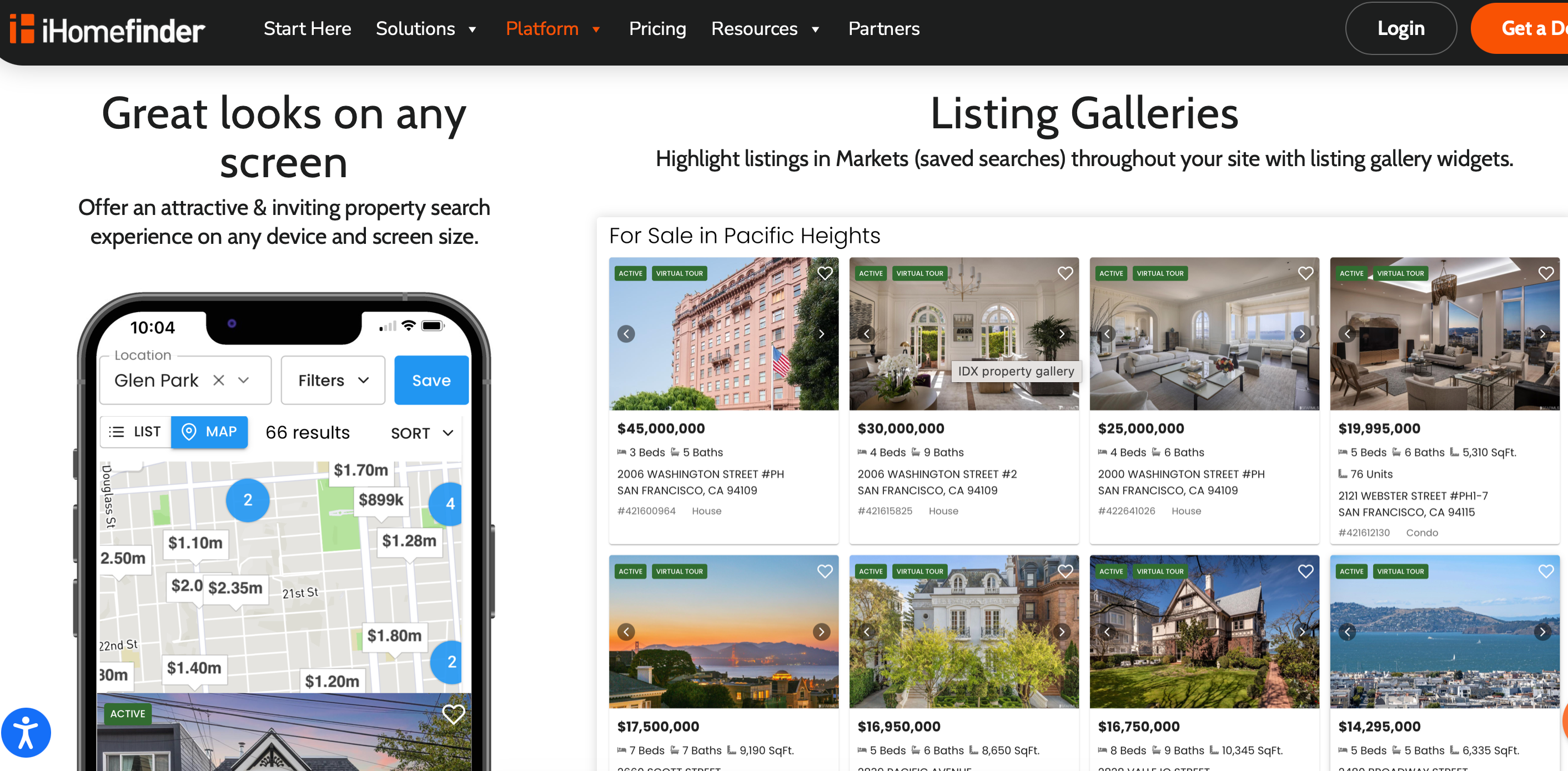
Common Features: MLS listings integration
- Key features include advanced property search with granular filters, support for managing one or multiple websites, and customizable options for branding and flexibility.
- Integrated marketing tools such as lead generation, email campaigns, market reports, and CRM functionalities to enhance user engagement and lead nurturing.
- SEO-friendly URLs and automatically generated community pages.
- Robust lead capture tools (pop-ups, registration gates, behavioral tracking).
- Deep integrations with CRMs and marketing automation tools.
- Scalable infrastructure designed for teams and high traffic.
- EstateVue IDX is a notable example of a customizable WordPress IDX plugin tailored for Canadian real estate agents and brokers, offering branding control and user-friendly features ideal for small brokerages.
Pros
- Reliability: Technical maintenance is handled by the provider, reducing downtime.
- Strong SEO foundation: Most platforms are built to maximize organic reach out of the box.
- Cleaner data flow: User activity on the site syncs seamlessly with the backend CRM.
- Conversion focus: Design elements are optimized specifically to turn visitors into leads.
Limitations
- Higher investment: Monthly costs are typically higher than a simple plugin.
- Less DIY control: You may have less freedom to tweak the underlying code compared to a custom WordPress build.
- Ecosystem commitment: Moving away from a platform later can be more complex than deactivating a plugin.
IDX Platform vs IDX Plugin—Differences at a Glance
For agents trying to weigh the specs, here is how the two compare:
| Feature | IDX Plugin | IDX Platform |
|---|---|---|
| Setup and Maintenance | DIY; requires managing updates/hosting | Managed; provider handles technical upkeep |
| SEO Capabilities | Varies wildly; often limited indexing | High; built for crawlability and indexability |
| Performance and Speed | Dependent on your hosting plan | Optimized for real estate data loads |
| Lead Capture | Basic forms; fewer triggers | Advanced; behavioral tracking & forced registration |
| Customization | High design flexibility (if you know code) | Structured flexibility within proven templates |
| Scalability | Harder to scale without breaking | Built to grow with teams and brokerages |
Which Option Is Better for SEO (Search Engine Optimization)?
Native IDX solutions import MLS listings directly into your website’s database, allowing for indexable property pages and improved search engine visibility.
When comparing an IDX platform vs IDX plugin, consider that IDX plugins can create indexable property pages (also called listing pages) for each property, which helps improve SEO for real estate websites.
Using an IDX plugin can lead to better search engine rankings because property pages become indexable content under your domain name. This means your site can have dozens, hundreds, or even thousands of listing pages that could attract search traffic, improving overall site visibility.
Additionally, search listings functionality is enhanced by organic IDX solutions, which allow search engines to crawl and index individual property pages. This organic approach gives you greater control over display and design, and helps your site rank for local real estate search queries.
IDX Plugin SEO Considerations
Plugins can be hit-or-miss with SEO. Some use “iframes,” which means Google can see the search bar but cannot “read” the actual listings inside the frame.
While modern plugins have improved, they often struggle with URL structures. You might end up with messier links that search engines miss. Additionally, because plugins sit on shared hosting environments, page load speeds (a critical Google ranking factor) can suffer.
IDX Platform SEO Considerations
Platforms generally win the SEO battle because they create a unique, indexable page for every property listing.
They handle the “schema markup” (code that helps Google understand the page is a house for sale) automatically. Platforms also excel at internal linking, automatically connecting similar properties and neighborhoods, which signals authority to search engines. If you want a long-term organic strategy, a platform offers a much stronger starting point.
Big Picture: Plugins can provide basic visibility for a business card site, but platforms are superior for sustained organic traffic growth.
Which Option Is Better for Lead Capture and Generation?
Getting traffic is only half the battle—capturing the lead is the other, equally important side of the real estate equation.
IDX Plugin Experience
Plugins typically offer passive lead generation. They might provide a “Contact Me” button or a “Request Showing” form.
While functional, they rarely track what the user did before they filled out the form. You might get a name and email, but you won’t necessarily know which homes they viewed or how often they visited.
IDX Platform Experience
Platforms are more aggressive about conversion. They use behavioral tracking to see exactly which properties a user is viewing, saving, or revisiting. They can trigger registration pop-ups based on user behavior (e.g., “Sign up to see more photos”).
Crucially, platforms usually offer a cleaner handoff to your CRM. Instead of just getting an email alert, the lead—and their entire search history—is injected directly into your database, allowing for smarter follow-up.
IDX Platform vs IDX Plugin: Which Is Right for You?
There is no single “best” choice, but there is likely a right choice for your current business stage. Choosing the right IDX plugin or the right IDX WordPress plugin is crucial for your real estate business, as it can significantly impact your website’s functionality, lead generation, and branding.
Use an IDX plugin if:
- You are a solo agent with a simple brochure-style website.
- Budget is your primary constraint and you need to keep costs minimal.
- You are comfortable troubleshooting WordPress issues or paying a developer to do so.
- SEO and automated lead routing aren’t top priorities right now.
- Plugins on WordPress are recommended if the website is a long-term business asset for lead generation and branding.
Use an IDX platform if:
- You rely on organic search to fill your pipeline.
- You need clean data flow into your CRM for automated nurturing.
- You are part of a team or brokerage that needs to route leads to multiple agents.
- You want to focus on selling real estate, not updating website software.
Common Misconceptions About IDX Plugins and Platforms
When shopping for technology, it is easy to fall for marketing jargon. Here are a few myths to watch out for.
“They’re basically the same”
While they both display homes for sale, the engine driving them is different. It is the difference between towing a trailer with a sedan (plugin) versus driving a truck built for hauling (platform).
“Plugins are always cheaper long term”
The monthly fee might be lower, but the hidden costs of premium hosting, developer fees, paid security certificates, and paid addons for lead capture can eventually rival the cost of an all-in-one platform.
“SEO is the same either way”
Google treats specialized architecture differently than generic WordPress pages. The ability to control URL structures and sitemaps gives platforms a distinct advantage.
“You can always switch later without impact”
Migration is possible, but switching IDX providers often changes your URL structure. If you switch later, you risk breaking the SEO equity you built up on your old links.
How to Evaluate IDX Solutions Before You Choose
Before signing a contract or installing a plugin, run through this checklist to ensure the tool meets your needs.
- MLS Import and Providers: Does the solution support direct MLS import using modern standards like RESO Web API, and does it work with your MLS providers?
- MLS Feed Integration and Multiple MLS Feeds: Can the plugin integrate with your MLS feed(s) and support multiple MLS feeds for comprehensive property data management? This is crucial for displaying listings from various MLS sources and keeping your real estate listings up to date.
- Compliance and Website Owner Role: Does the plugin help the website owner ensure compliance with IDX regulations and MLS rules? Remember, only an MLS member can access MLS data, and the website owner is responsible for maintaining compliance and data accuracy.
- Indexing: Ask specifically if the provider creates a unique, indexable URL for every listing, or if they use framing. IDX listings should be SEO-friendly and provide detailed property information for each property.
- Displaying Listings & Searchable Property Listings: Does the plugin allow for displaying listings, creating searchable property listings, and building community pages? Features like advanced search tools, property details customization, and widgets/shortcodes are essential for user engagement.
- Installation: IDX plugins can be installed and activated similarly to other WordPress plugins, providing tools for managing and displaying property listings.
- Real-Time Data: IDX plugins connect WordPress sites directly to MLS listings, allowing buyers to browse properties in real time and access detailed property information, enhancing the user experience.
When you think through these factors, your real estate website is better equipped to keep up with industry changes, deliver full, accurate listings, and serve both website owners and real estate professionals effectively.
Final Takeaway: Plugin vs Platform Isn’t Just Technical
Choosing between an IDX plugin and a platform isn’t just a technical decision—it’s a business strategy choice. If your website is simply a digital business card intended to validate your existence to referrals, a plugin is a perfectly acceptable, cost-effective solution.
However, if you view your website as a revenue generator—a tool intended to attract strangers, capture their information, and nurture them into clients—a dedicated IDX platform provides the infrastructure necessary to support that goal. Growth requires stability, and a platform offers the foundation required to scale.