

How to Integrate IDX, CRM, and Automation
How to Integrate IDX, CRM, and Automation
If you’re a real estate agent, you probably use a collection of different tools to manage your business. You might have an IDX website for listings, a separate CRM to track leads, and another tool for email marketing. While each system serves a purpose, juggling disconnected platforms creates a major problem: leads fall through the cracks. Having your own website with IDX integration allows brokers and realtors to generate leads and compete directly with large portals like Zillow, giving you more control over your business and client relationships.
Without a unified system, your follow-up is slower, your outreach is inconsistent, and your client data is incomplete. Leads that show strong buying signals on your real estate website go unnoticed, and potential deals are lost simply because brokers and realtors couldn’t act fast enough to manage listings or protect client data.
So, how do you fix this? The solution is to integrate your IDX website, CRM, and automation tools. Integrating IDX with your own website and CRM is key for real estate professionals to generate leads and build a competitive advantage. This guide will show you how to build that seamless system to convert more leads and close more deals.
How IDX, CRM, and Automation Work Together for Real Estate Professionals
To understand why integration is so powerful, it helps to first understand the specific role each component plays in your real estate business.
IDX (Internet Data Exchange)
This is your primary tool for lead capture and collecting behavioral data. IDX transforms your real estate website into a dynamic home search engine, allowing visitors to perform property searches using up-to-date MLS listings from the Multiple Listing Service (MLS).
Your IDX website is where potential clients view MLS listings, save their favorite properties, and set up alerts for new homes on the market. Each property from the MLS is displayed on its own page, which can be indexed by search engines and improve your site’s visibility. Every action a visitor takes is a valuable piece of information about their intentions.
CRM (Customer Relationship Management)
This is your command center for lead management and prioritization. Your CRM stores contact records, tracks interactions, and helps you organize your sales pipeline. With features like lead scoring, it can tell you which prospects are ready for a phone call and which ones need more nurturing.
Automation
Automation is what ensures timely follow-up and consistent communication. Specific tools can send email or SMS campaigns, trigger reminders for agents, and deliver personalized content based on a lead’s behavior. It works 24/7, so you never miss an opportunity to engage.
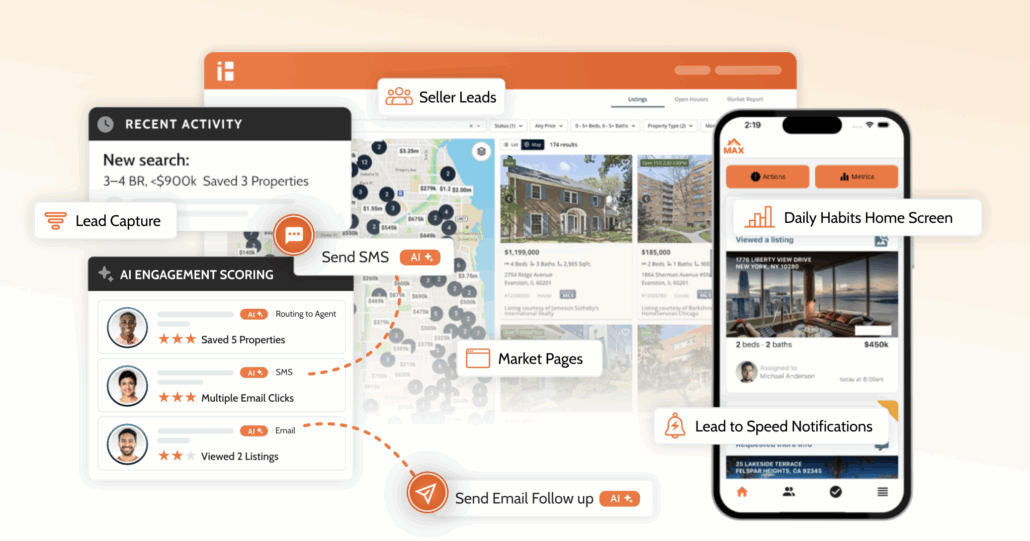
When these three systems are synced, agents gain full visibility into a lead’s journey, and the lead receives a personalized, timely, and relevant experience.
Why Integrating Your Tools Is Crucial for Conversions
Connecting your systems isn’t just about convenience; it’s about building a workflow that actively helps you convert leads at the bottom of the funnel. Seamless IDX and CRM integration enhances lead generation by attracting more visitors to your real estate website and making your listings more visible to search engines. Here’s why integration matters.
✔ Faster Response Times
When a lead saves a property or views it multiple times, an integrated system can instantly trigger an alert in your CRM, notifying the assigned agent to follow up immediately.
✔ Better Personalization
IDX activity gives you powerful insights. If a lead is looking at three-bedroom homes in a specific neighborhood, your automation can send them a targeted email with similar listings, making your outreach feel personal and helpful.
✔ No Duplicate or Missing Data
With a single, unified system, every interaction—from a website visit to an opened email—is logged in one central contact record. This eliminates data entry errors and gives you a complete history of every lead.
✔ More Consistent Follow-Up
Agents get busy. Automation fills the gaps by nurturing leads with market updates, property alerts, and helpful content until they are ready to talk. This ensures no lead ever feels ignored.
✔ Higher Conversion Rates
An integrated system uses AI and behavioral signals to surface the hottest leads automatically. This allows your team to focus their time and energy on prospects who are most likely to convert.
What Does a Seamless Real Estate Workflow Look Like?
It can be hard to visualize how these pieces fit together. Here’s a step-by-step example of a perfectly integrated workflow in action.
Many real estate professionals use IDX Broker or similar IDX websites, which offer customizable templates to create a branded and user-friendly home search experience.
- Step 1: A Lead Visits Your IDX Website
- A potential buyer lands on your real estate IDX website. They browse listings, save a few favorites to their profile, and set up new listing alerts for upcoming properties in their desired area or neighborhood. (These saved properties clue you in on what they are looking for.)
- Step 2: The Lead Instantly Syncs to Your CRM
- As soon as they register, a new contact profile is automatically created in your CRM using real-time lead data. You don’t have to lift a finger.
- Step 3: Their Behavior Triggers Automation
- The system recognizes their actions. Saving a search might trigger a drip campaign with tips for homebuyers. Viewing the same property three times could send an urgent alert to an agent. A showing request is automatically routed to the right team member.
- Step 4: The Agent Receives a Prioritized Task List
- Your agent logs in to see a clear, prioritized list of tasks. The system uses an AI-powered lead score and recent engagement data to tell them exactly who to call first.
- Step 5: The System Continues Nurturing
- Even after the agent steps in, the system continues to work in the background, sending relevant property alerts and market updates to keep the lead engaged throughout their journey.
How to Connect Your IDX, CRM, and Automation
Ready to build this workflow for your team? Here are the steps to connect your systems and create a seamless lead management process.
- Choose a CRM with Native IDX Integration: Avoid trying to patch together separate tools with third-party connectors like Zapier. A platform with native integration ensures real-time data sync and eliminates technical headaches. Some platforms also support integration with multiple MLSs, expanding your reach and listing coverage.
- Set Up Behavioral Triggers: Inside your CRM, define which user actions should trigger a specific follow-up. For example, set up automations for new property alerts, price drop notifications, and saved search updates.
- Build Workflows for Each Funnel Stage: Create different automation campaigns for each stage of the buyer journey. A new lead might get a welcome series, a highly engaged lead might trigger an agent alert, and a long-term prospect could receive a monthly market report.
- Configure Smart Lead Routing: Ensure every lead is sent to the right agent instantly. Set up rules based on geography, price point, property type, or agent availability to distribute leads fairly and efficiently.
- Sync All Communication Channels: Your system should be the single source of truth. Integrate your email, SMS, and showing requests so that all communication is tracked in the lead’s contact record. Integrating with other tools, such as marketing platforms or scheduling apps, can further streamline your workflow. Throughout your real estate website, using links for navigation, social sharing, and lead generation is essential for user engagement and transparency.
- Track Performance in One Dashboard: A unified system should offer a central dashboard to monitor key metrics like conversion rates, follow-up speed, and overall team activity. This gives you the insights you need to optimize your process.
Must-Have Features to Integrate IDX CRM, and Automation
When evaluating platforms, look for an all-in-one solution that includes these essential features:
- Real-time IDX website and behavior sync
- Real estate agent websites that are both eye-catching and functional
- AI-powered lead scoring
- Automated email and SMS follow-up campaigns
- Customizable drip campaigns and property alerts
- Smart lead routing for teams
- Mobile alerts to improve agent response time
- A centralized dashboard for team visibility and collaboration
Property Alerts and Notifications: Keeping Clients Engaged
Property alerts are one of the simplest ways to keep clients and potential clients informed and actively moving through your pipeline in a busy real estate market.
When your CRM and IDX work together inside a unified platform, you can automate these alerts so every buyer gets real-time updates based on the property listings they care about most.
Here’s how to make this feature actually work for you:
Match Alerts to Real Search Behavior
Use your real estate CRM data to set alerts based on a client’s saved searches, viewed homes, price filters, and must-have features. This helps you capture leads who are actively looking—not just browsing.
Send Updates the Moment Something Changes
New property listings, price drops, and status updates can go out automatically without you having to check the MLS every hour. Small teams benefit most here because automation fills the gaps when you’re busy or out showing homes.
Turn Alerts into Conversations
Every automated notification should give you a natural reason to follow up. When a client clicks on an alert or revisits a listing, trigger a quick check-in task or message inside the same platform.
Keep Everything in One Place
Managing alerts, client activity, and your property listings from one platform helps you avoid missed messages or scattered follow-ups. It also makes it easier to spot which potential clients are heating up and which need more attention.
Top takeaway: When you treat property alerts as a built-in engagement system (rather than another feature), you create a predictable way to keep clients informed, stay top of mind, and move buyers toward the next step. This is one of the fastest wins a unified platform can give busy agents and small teams.
Common Mistakes to Avoid
As you integrate your tools, steer clear of these common pitfalls:
- Using Separate Systems: Juggling platforms that don’t share data defeats the purpose of integration. Plus, it leads to more manual work and fixes down the line.
- Over-Automating: Automation should support, not replace, personal connection. Ensure your workflows leave room for genuine agent interaction.
- Failing to Update Workflows: The market and your clients’ needs change. Review and refine your automation rules regularly to keep them relevant.
- Lacking Ownership: Designate a team member to own lead routing and follow-up processes to ensure accountability.
Is Your Real Estate Workflow Seamless?
How do you know if your integration efforts have paid off? You’ll see tangible results across your team. A seamless workflow means every lead is captured, followed up on, and nurtured automatically—without agents needing to babysit the system.
You’ll notice:
- Faster agent response times.
- Fewer missed follow-up opportunities.
- Higher lead conversion rates.
- Clearer visibility into your sales pipeline.
- More consistent outreach across the entire team.
- Less time spent on manual data entry.
Build Your All-in-One System Today
Disconnected tools don’t just create extra work—they cost you deals.
By integrating your IDX, CRM, and automation, you create a powerful, efficient system that captures every opportunity and empowers your agents to do what they do best: build relationships and close deals.
iHomeFinder connects your IDX site, CRM, and automation into one seamless platform designed to help you convert more leads. With real-time behavior sync, AI lead scoring, and automated follow-up, our system gives you everything you need to grow your real estate business.
See how iHomeFinder can unify your tools and streamline your workflow.
Frequently Asked Questions
Why is IDX and CRM integration important?
It brings real-time website activity directly into your CRM, making your follow-up more targeted, timely, and effective. You can see exactly what leads are interested in and tailor your communication accordingly.
Can automation replace agent follow-up?
No. Automation handles the consistent, repetitive tasks, ensuring no lead is ever ignored. This frees up agents to focus on high-value activities, like making personal calls and building relationships with qualified prospects.
Will integrating these systems improve my conversion rates?
Yes. Teams that use integrated systems typically see better response times, clearer visibility into their pipeline, and a higher number of qualified leads, all of which contribute to improved conversion rates.
Do I need multiple tools to make this work?
Not if you choose the right platform. An all-in-one solution that combines IDX, CRM, and automation natively is the most effective way to create a truly seamless workflow without the complexity of managing multiple vendors.

